The KSMP wants to be sure that every veterinary student knows about the generous offer extended by our friends at the Association for Animal Welfare Advancement (AAWA). If you are actively enrolled in a veterinary college, you can attend AAWA’s conferences for FREE!
The Association’s next conference will be held the first week of December and will include special guest Vu Le, executive director of Nonprofit AF.
It’s an especially exciting time for veterinary students to be able to attend conferences and gain an insider’s peek at the changing landscape of animal welfare. Here are a few of the topics students are invited to participate in:
Equity, Diversity, and Inclusion in Hiring Philosophy and Practices
Collaboration: Understand, Align, and Transform
Practicing Compassionate Badassery: How to Cope with COVID-19
Technology to Safely Onboard, Support & Engage Volunteers During and Past COVID
Breaking Happy: A Path to a Sustainable Career
Recruiting Today’s Hourly Workers: It’s Different. And It’s Not.
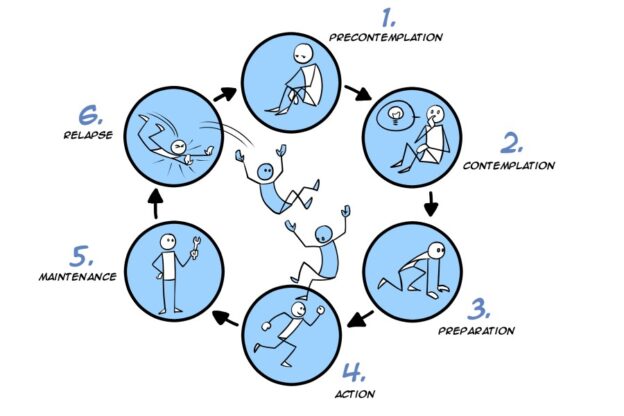
Last week we talked about change curves and took a moment to recognize that important change goes through a cycle just like grief. In fact, if you took a moment to glance at the Kubler-Ross Change Curve you might have noticed it looked pretty dang familiar to you. The five stages of change happen to be, you guessed it, the exact same five stages of grief! It’s true: Our minds grieve change even when it’s good. A big breakup still hurts even if we know it’s time to move on.
Understanding that letting go of the way we did things is a process, even if the way we did things wasn’t serving us, helps us prepare for the ride and know when we need to act vs when we simply need to hold on. Knowing that stakeholders’ fear, anxiety, anger, frustration, and helplessness are to be expected, we can see those reactions as a sign that we are on the right track when we are managing the change appropriately.
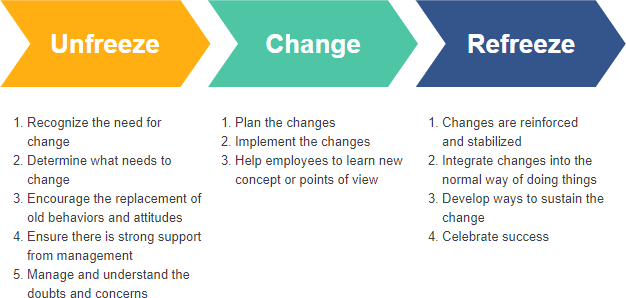
That doesn’t mean we should let go of the wheel, of course. What we can do to successfully set our organization up for the change ahead, the “unfreeze” stage of the Kurt Lewin Change Model, is to prepare our organization by:
+ Framing the problem and breaking down the status quo. This stage includes challenging the beliefs, values, attitudes, and behaviors that currently define the problem and being willing to look at the biases that enabled us to land here in the past. Using the analogy of a building, we must examine and be prepared to change the existing foundations as they might not support new additions. This may evoke strong reactions in people, and that’s exactly what needs to be done. We’re effectively creating a controlled crisis, which in turn can build a strong motivation to seek out a new equilibrium. Without this motivation, you won’t get the buy-in and participation necessary to effect meaningful change. Covid, of course, accelerated our first step- for better or for worse.
+ Communicating to our stakeholders why the status quo isn’t working and why we need the change. This might be especially hard when we’ve found ways to celebrate old policies/metrics that really weren’t serving us. This step requires a bit of honesty, humility, and an honest effort to change the narrative going forward. (Thankfully, those are all traits of a great leader and showing openness and vulnerability during change serves to deepen trust and respect.)
+ Soliciting feedback: Openly, honestly, anonymously, regularly and without repercussion. Whether it’s a conversation, a survey, a private suggestion box, town hall meetings or just picking up the phone to call individual staff members, the answer is YES. Make clear the only promise associated with the feedback is that it will be heard and the concern will be addressed.
+ Addressing, managing and responding to fears and…
+ Messaging, messaging, messaging and messaging some more about the gains made along the ride, not just at the end. The change cycle tells us there will be dips and losses along the way. Don’t let those expected setbacks become the narrative that keeps fears stoked.
When it comes to the community, tell your story through a service-oriented lens.
Abe Lincoln once said, “Give me six hours to cut down a tree and I’ll spend the first four sharpening the axe.”
You might feel like you’ve been messaging and talking about policy changes for 24 hours a day 7 days a week since March, 2020, but it’s easy for us to forget that our shelter world, the thing we live and breathe every single day, is a place, a service, that most people only interact with a few times in their lives. The most well-resourced shelters in the country with a team of marketers behind them are doing great to have an online following that’s 10% as large as the city or county they serve. Of those, less than 6% will see a post you make on social media. The point: Don’t be surprised to find your community is still surprised by the improvements you’ve made to your customer and animal experience. Expect that they have no idea what or why things are different and relish in the opportunity to tell them how you are realigning and expanding your services to meet their needs and the needs of the animals.
How do these changes directly benefit the animals? How do they benefit stakeholders?
● If you fumbled around for a few weeks testing new technologies that would allow your animals to meet their match online and now they’re out there swiping left with potential adopters– tell that story! Does every person visiting your website know they can meet their next best friend without getting off the couch?
● If you implemented an appointment-based system, whether it be for adoption or to surrender, tell your community what it means to be able to give your undivided attention to the pet and person sitting in front of you. Can they go online and schedule an appointment using a convenient calendaring app? Great! No one likes to wait, everyone likes clean surfaces, and, rest assured, every animal and adopter/guardian receives your team’s full attention when it’s their turn. Focused attention is the gold standard of good service, even more so when big decisions are being made.
● If you stopped taking in healthy cats, communicate why this change is in alignment with the recommendations made by leading national organizations. Most people simply don’t know that cats are ten times more likely to be reunited with their guardians when left in their neighborhood of origin.
● If you emptied your shelter to upgrade your cat housing, show your supporters what it looks like when a cat steps through a portal. We all understand how critical having adequate space to move around is to our wellbeing now more than ever.
This is our story of change and it’s a great one. The most recent Shelter Animals Count data shows us that euthanasia is down by at least 100k lives this year compared to last and animals are spending a record low number of nights in cages. If your organization is feeling weary, unappreciated, misunderstood, or even under attack, bless and release what is not yours to worry about and hand it over to the life cycle of grief so you can spend all your time and attention shouting the positive changes for both animals and the people that love them from the mountaintops.
As the months move on and we settle into our new rhythm, some of our redesigned-by-Covid programs are starting to feel old hat now. While there is not a one-size-fits-all solution for every shelter, we know many of you have attempted to safeguard your shelter staff and community by reducing touch points. You moved to appointment-based services and extended your care options to include online/phone consultations, and you implemented curbside drop-off/pickup to manage contact and avoid crowded lobbies. You added parking spots with “text for service” messaging and moved your foster training online. Some of you launched home-to-home programs that bypass the shelter altogether, while others changed the direction of field officers’ vehicles by offering “foster delivery” services and suspending healthy “stray” (were they really lost?) cat pickup.
Despite most of these changes taking place rapidly under crisis conditions, we seem to be getting it right. The overwhelming response from shelter professionals has been clear: We’re not going back!
“Our animals are less stressed, dog bites are down, our staff loves the new appointment-based model…it started out scary, but it’s been great for our animals!”
California Animal Shelter Covid Action Response member
As a sheltering community, we’ve accepted chaos as inevitable. Stress and overwhelm are inherent; our cross to bear for doing this work. Covid brought business as usual to a grinding halt, a momentary pause that had the unintended but remarkable consequence of propelling the animal welfare industry forward a decade or more.
From where we stand (6 ft apart) today, we know overwhelm doesn’t have to be the norm. We know that our community will step up when we make room for them. We’ve seen the other side, a place where we operate within capacity and proactive policy making replaces reactive decision-making. We have felt the difference of a day that was predicted, scheduled, and managed versus another day that was survived.
Most importantly, we’ve been allowed space and time to give excellent service to both pets and their people and we’ve witnessed firsthand the difference time and attention makes to our outcomes.
It’s no surprise the question on the proverbial streets has turned proactive, too: How do we institutionalize these changes before we slide back to the way it used to be? Change experts would tell us the most critical step is to invite our stakeholders to hold the line with us by telling our story of transformation through transparent, value-first communication and asking them to be ambassadors of change.
Sounds easy enough, right? So why is there still a knot in our stomach.
Well, because this is animal welfare. A world in which people care an awful lot. Emotions and unchecked fears often bubble up and over, wreaking havoc on our best intentions. We all know a story of a shelter/rescue being dragged through the mud after instituting a new policy. Many of us have been a story. Despite our very best intentions, it’s not pretty when we lose control of the narrative.
So how do we get in front of it? How DO we tell our own story and drive positive change forward when emotions run high? The answer is by understanding the change process and what we should expect around every bend. Knowing what to expect allows us to be prepared to lead the positive messaging and not scrambling to react to mud being thrown our way. To stay ahead of the change (and its reputation), we have to know and address the concerns of our stakeholders. Unattended stakeholder fears are the enemy to progress!
Last week we shared a link to a free resource, Change Management: The Role of Strategic Communication. (Heads Up: You have to scroll down a list of free resources offered by Brighter Strategies to find the Strategic Communication workbook. You’ll need to enter your email to receive the downloadable workbook, but it’s worth it and they aren’t too spammy.) Take a moment to familiarize yourself with the Kubler-Ross curve and the stages of change. Ask yourself:
Is the change we are experiencing proactive or reactive?
What stage(s) of the Kubler-Ross curve are our staff, volunteers and/or board at?
Based on our stage and the nature of our change (i.e. proactive or reactive), what are the emotions our stakeholders are likely experiencing?
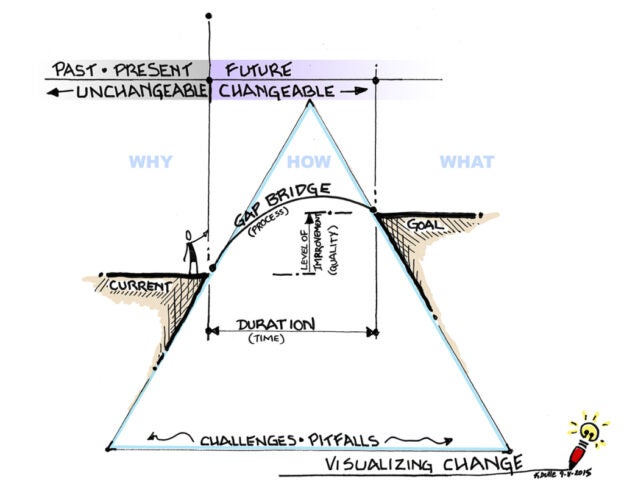
To successfully move the change effort we want to see through our organization and our community, or to make a temporary change permanent, we have to complete the change cycle. Next week we are going to dive into what to do when a pandemic caused us to skip the first step of the change cycle and how we can go back to gather stakeholders left behind and move forward together.
Until then, have a peek at the Kurt Lewin Change model and take a moment to decide if you would classify your organization as being in the “unfreeze” stage, the “change” stage, or the “freeze” stage.
+If you are feeling good: What makes you feel like you’ve moved on to stage two and are ready to do or are already doing the work associated with big change? Was there a moment you knew you had support and buy-in?
+If you are feeling unsure, fearful or uneasy: What makes you feel like you are stuck in stage one? Do you feel community pushback is keeping you from making progress? How is that pushback showing up?
We’d love to hear from you! Please email us at sheltermedicine@ucdavis.edu and share what it’s like to be experiencing BIG change at your shelter right now. We want to hear the good, the bad, and the ugly.
When we are going through a big change, especially change that was unplanned, it can be difficult to stop and communicate the process with our stakeholders. Not only are we consumed with managing our evolving processes, but it’s hard to speak with certainty when things are fluid. When you think about speeding down an unfamiliar hill on your bike, it’s probably not your first instinct to narrate your every move.
Still, change management experts tell us that now is not the time to keep quiet. Even when our process is in flux, it is to our advantage to communicate early and often with stakeholders to ensure we are telling our own story and not leaving space for blanks to be filled in by those that are not fully informed. Does the idea sound daunting? Not sure where to start?
The role of strategic communication during change management cycles is a popular topic any day, but the shift of our world on its axis has propelled this discussion to the front of the interwebs. There’s a plethora of sound guidance to be had and, for once, an almost unanimous agreement: A good change management strategy requires a detailed plan that considers each of your stakeholder groups and addresses the fears associated with their particular investment.
In this downloadable eBook, Change Management: The Role of Strategic Communication, offered by Brighter Strategies, you’ll be walked through the Change Cycle and the corresponding exercises of developing your communication strategy. You’ll also learn why Stage 2 is the most dangerous stage, making Stage 1, straight out of the gates, the most important time to start communicating and telling your story.
Example: Here’s a great little video created by VIN for the veterinary community to communicate with their clients why it’s been difficult to schedule an appointment.
If you were a frustrated client, would you still be upset after watching this? Or does the vulnerability, clarity, transparency, and your-safety-first messaging have you making a note to send a thank you message (with a hug inside) to your own veterinarian right now?
If we want our community to have our back during times of transition, we have to remember to take them along for the ride from the beginning. Tell your story before someone tells it for you. Show your stakeholders how you are not only adapting but thriving (or at least trying to) in the face of crisis. Talk to them even when you are just trying something out.
Have you created a video similar to the one VIN created? We’ll be talking about communication during transition for the next few weeks and we’d love to hear from you. Email us at sheltermedicine@ucdavis.edu and tell us about your communication strategy with your stakeholders. How are you training staff to communicate with clients? What you’re noticing is really resonating with your community members? Would you try anything differently next time?
Now, in the age of COVID, she’s at it again, this time pivoting her programs to keep her staff and community safe by exponentially growing the safety net outside her shelter walls.
If you missed this webinar, watch and find out how HSSV’s Chief of Shelter Medicine, Dr. Kamiya, led the charge to onboard 3,000 new foster homes since March AND leverage her volunteer time and talent to support the effort.
Join us this Thursday, September 3rd to dive deep into getting kittens into their new homes in our new normal (and the future)!
Date: Thursday, September 3, 2020, 12 PM Pacific/3 PM Eastern
Presenter: Dr. Sara Pizano, DVM, MA
In this webinar, the fifth and final of a five-part series presented in partnership with Royal Canin and hosted by Maddie’s Fund, we’ll learn how to take our matchmaking game from the adoption floor to the worldwide web.
Our industry is changing fast; early-adopting shelters are already reaping the benefits of modernizing their adoption programs. Online meetups, adoption appointments, automated scheduling, Facetiming cats and virtual paloozas: It’s a whole new matchmaking world out there!
Still have questions? Stay for the Q&A!
Join us on Thursday, September, 3, 2020 at 12 PM Pacific / 3 PM Eastern
The webinar is 90 minutes long with about 60 minutes dedicated to presentations and panel interviews and an additional 30 minutes reserved for Q&A. This webinar will be recorded.
What will I learn? This is the third webinar in a five part series covering all things kitten management. In this episode we’ll:
Learning objectives
Learn about national adoption trends in the COVID age
Promote to different audiences and grow your pool of adopters
2020 your adoption process – payments, document storage, signatures and appointments- oh my!
When money is tight: Squeezing the biggest bang out of your adoptathon buck
In this webinar, the fourth of a five-part series presented in partnership with Royal Canin and hosted by Maddie’s Fund, we’ll go inside the shelter to find out what’s new in the world of kitten care, pathway planning, wellness, and pediatric spay/neuter. We’ll discuss which shelter protocols are impacting flow-through and length-of-stay, which kittens should stay in the shelter and for how long, what you should consider when modernizing your sterilization protocols, and how technology is advancing our shelters by maximizing our efficiency. Still have questions? Stay for the Q&A!
Join us on Thursday, August 27 at 12n Pacific / 3pm Eastern
The webinar is 90 minutes long with about 60 minutes dedicated to presentations and panel interviews and an additional 30 minutes reserved for Q&A. This webinar will be recorded.
What will I learn? This is the third webinar in a five part series covering all things kitten management. In this episode we’ll:
Review kitten medical care in the shelter – intake care and wellness care protocols and intervals.
Understand the goals for kitten flow through the sheltering system and how our policies and protocols impact length of stay and lifesaving capacity.
Which kittens should stay in the shelter and for how long.
Using technology and advances in sheltering to maximize efficiency of providing care to kittens in the shelter and in foster (protocols, templates, email lists, appointment scheduling software, telemedicine, automated reminders, website resources for fosters/staff, LMS use)
Take a deep dive into pediatric spay/neuter – what age/weight is the “right” age/weight and why
Understand special considerations for pediatric spay neuter to minimize morbidity/mortality
Communicating programs and protocols to stakeholders for understanding and support
Develop a clear picture of what each kittens pathway will look like through the shelter
We all know fosters make the world go round! This Thursday the Million Cat challenge is presenting the third webinar in the five-part kitten management webinar series: Foster Greatness. Join us as we dive in to the heart of community-centric sheltering: foster care.
Gone are the days of handwritten applications and in-person volunteer orientations. Foster programs are evolving at lightning speed, leveraging new technologies to give their program a digital makeover. If you’d like to recruit, train and onboard volunteers quicker, better, faster, then grab your foster coordinators and a seat in this action-packed webinar now.
Join us on Thursday, August 20 at 12n Pacific / 3pm Eastern for a 60-minute presentation and plenty of time for Q&A with Dr. Sara Pizano.
This webinar will be recorded.
The webinar is 90 minutes long with about 60 minutes dedicated to presentations and panel interviews and an additional 30 minutes reserved for Q&A.
Here are the details: Dr. Sara Pizano will be hosting an interview-style webinar with three Million Cat Challenge shelters and the founder of FosterSpace, the newest suite of tools brought to you by Doobert.
What will I learn? This is the third webinar in a five part series covering all things kitten management. In this episode we’ll:
Turn your foster program into a trifecta (win for the kittens, win for your fosters, win for you)
Leverage the newest platforms and tools that deliver volunteers to your door – trained!
Modernize your application and training program. Foster/volunteer-centric.
Save time, money and hassle by upping your foster scheduling game.
Empower your volunteers to expand your lifesaving capacity by giving them the tools they need to do their own adoptions.
This week the Million Cat challenge is stepping up with some heavy hitters– Dr. Julie Levy, Fran Marino Professor of Shelter Medicine Education at the University of Florida, co-founder of the Million Cat Challenge and founder of Operation Catnip; Kristen Hassen-Auerbach, Director at Pima Animal Care Center, Board of Directors of the National Animal Care and Control Association, Executive Committee for American Pets Alive! and Human Animal Support Services; Nick Lippincott, Special Programs and Training Programs Coordinator, Orange County Animal Services (Orlando, Florida) Board member, National Animal Care & Control Association; Dr. Heather Kennedy, Director of Feline Operations at KC Project– to present the second webinar in the five-part kitten management webinar series: Supporting Kittens in the Field. The webinar is 90 minutes long with about 60 minutes dedicated to presentations and panel interviews and an additional 30 minutes reserved for Q&A.
Here are the details: Supporting kittens and their families starts before they show up on your intake counter. Find out what field officers, volunteers and fosters are doing to give kittens the best chance of survival while streamlining operations and expanding safety nets outside shelter walls.
What will I learn? This is the second webinar in a five part series covering all things kitten management. In this episode we’ll:
Identify ways you might be sabotaging your own goals by swimming upstream.
Access your shelter’s opportunity to leverage ACOs, Field Officers and/or volunteers to better serve kittens outside your walls and ensure resources for the ones inside your shelter.
Activate your community to achieve your kitten goals.
Increase your kitten LRR, decrease your kitten budget.
HYPER unify your messaging and alleviate the burden on your frontline staff.
Learn two software tools that allow you to “set it and forget it”
What did I miss? Each of these webinars is designed to be stand alone, but together they make up a series that starts at intake decisions and ends at positive outcomes and adoption. To catch what you missed last week, please visit: Million Cat Challenge: Kitten Intake in Animal Shelters
Join us on Thursday, August 13 at 12n Pacific / 3pm Eastern for a 60-minute presentation and plenty of time for Q&A with Million Cat Challenge co-founder Dr. Julie Levy.
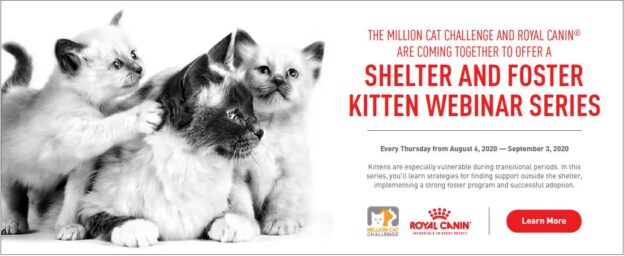
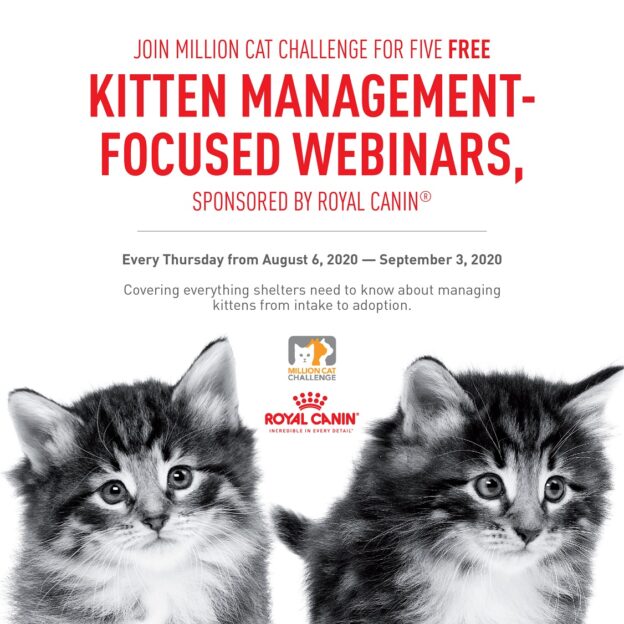
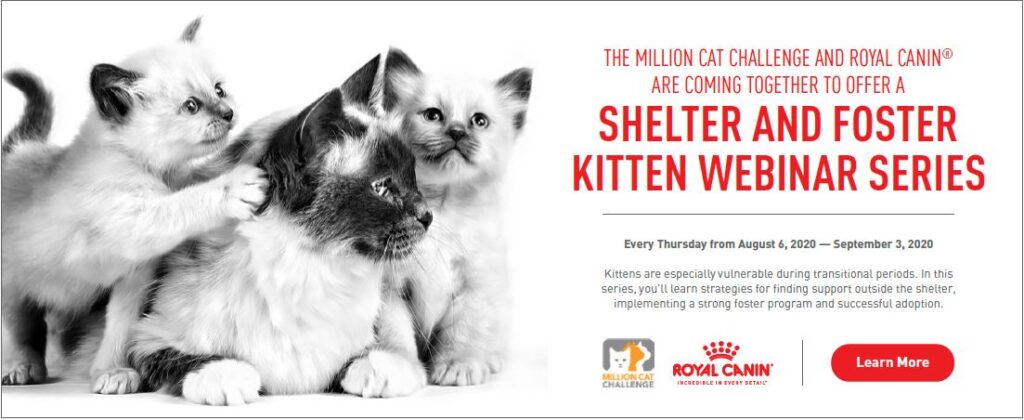
We all know kittens are at risk during transitional periods. In fact, they remain the most vulnerable species to enter our sheltering systems. That’s why the Million Cat Challenge and Royal Canin have partnered up to bring shelters an all inclusive, tip-to-tail free webinar series that explores community-focused sheltering strategies that expand our kitten safety net.
Join experts as they dive into new and emerging kitten intake philosophies and discuss when kittens are best served outside shelters walls, streamlining your foster program, providing mom and kitten support, pediatric spay and neuter and successful adoption strategies that will send these tiny cats out the front door two by two.
Register now to save your spot and watch live every Thursday @ 12pm PST! Series runs from the first Thursday in August (8/6/20) through the first Thursday in September (9/3/20).
1. Kitten Intake in Animal Shelters – 8/6/20
Length: 90 minutes (60 presentation, 30 min Q+A)
Dr. Kate Hurley, together with Hannah Shaw, a.k.a. the Kitten Lady, we’ll discuss new intake philosophies and management models that prioritize kittens’ safety, community engagement and keeping feline families together. Plus! Find out about the industry powerhouses that are stepping up to support you in your next chapter of kitten lifesaving.
Join us on Thursday, August 6 at 12n Pacific / 3pm Eastern for a presentation and Q&A with Million Cat Challenge co-founder Dr. Kate Hurley and Hannah Shaw (the Kitten Lady).
Maddie’s Fund® has applied for advanced approval of Certified Animal Welfare Administrator continuing education credit.
Speakers – Kate Hurley, DVM, MPVM, Dip. ABVP (Shelter Medicine) and Hannah Shaw
2. Support for Kittens in the Field – 8/13/20
Length: 90 minutes (60 presentation, 30 min Q+A)
Description Supporting kittens and their families starts before they show up on your intake counter. Find out what field officers, volunteers and fosters are doing to give kittens the best chance of survival while streamlining operations and expanding safety nets outside shelter walls.
Join us on Thursday, August 13 at 12n Pacific / 3pm Eastern for a presentation and Q&A with Million Cat Challenge co-founder Dr. Julie Levy.
Maddie’s Fund® has applied for advanced approval of Certified Animal Welfare Administrator continuing education credit.
Speaker – Julie Levy, DVM, PhD, DACVIM, DABVP
3. Foster Greatness – 8/20/20
Length: 90 minutes (60 presentation, 30 min Q+A)
Description Gone are the days of handwritten applications and in-person volunteer orientations. Foster programs are evolving at lightning speed, leveraging new technologies to give their program a digital makeover. If you’d like to recruit, train and onboard volunteers quicker, better, faster, then grab your foster coordinators and a seat in this action-packed webinar now.
Join us on Thursday, August 20 at 12n Pacific / 3pm Eastern for a presentation and Q&A with Dr. Sara Pizano.
Maddie’s Fund® has applied for advanced approval of Certified Animal Welfare Administrator continuing education credit.
Speaker – Sara Pizano, DVM, MA, Founder and Animal Welfare Strategist, Team Shelter USA, LLC
4. Kitten Care in the Shelter – 8/27/20
Length: 90 minutes (60 presentation, 30 min Q+A)
Description In this hour-long webinar, we’ll go inside the shelter to find out what’s new in the world of kitten care, pathway planning, wellness, and pediatric spay/neuter. We’ll discuss which shelter protocols are impacting flow-through and length-of-stay, which kittens should stay in the shelter and for how long, what you should consider when modernizing your sterilization protocols, and how technology is advancing our shelters by maximizing our efficiency. Still have questions? Stay for the Q&A!
Join us on Thursday, August 27 at 12n Pacific / 3pm Eastern for a presentation and Q&A with Dr. Cynthia (Cindi) Delany.
Maddie’s Fund® has applied for advanced approval of Certified Animal Welfare Administrator continuing education credit.
Speaker – Cynthia (Cindi) Delany, DVM, Shelter Veterinarian/Manager, UC Davis Koret Shelter Medicine Program; Executive Director, California Animal Shelter Friends, Inc.
5. Going Home – 9/3/20
Length: 90 minutes (60 presentation, 30 min Q+A)
Description Learn how to take your matchmaking game from the adoption floor to the worldwide web. Our industry is changing fast and early-adopting shelters are already reaping the benefits of modernizing their adoption programs. Online meetups, adoption appointments, automated scheduling, Facetiming cats and virtual paloozas: It’s a whole new matchmaking world out there!
Join us on Thursday, September 3 at 12n Pacific / 3pm Eastern for a presentation and Q&A with Dr. Sara Pizano.