
Shelter Learniverse and Industry-Wide Calendar

Author: mandy newkirk

  • What National RTO Averages are Not Telling us About Redemption.

    What National RTO Averages are Not Telling us About Redemption.

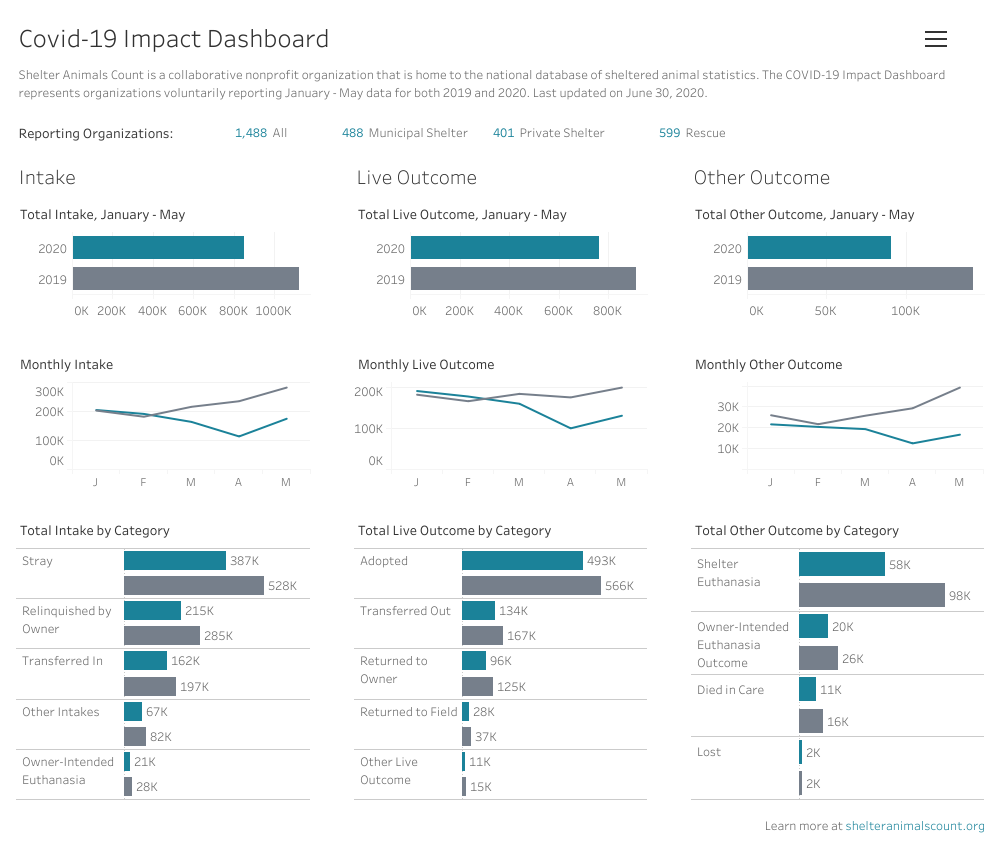
    According to the 2,760 organizations that report to Shelter Animals Count, national shelter intake is down over 25% for the first half of 2020; in some states, such as New York, animal intake is down as much as 55%.
    The stories behind these stats are good ones: Animals are being directly rehomed by their guardians; fosters are “failing” in love and keeping animals that would have entered the sheltering system; food, medical, and behavioral resources are being offered to keep animals in homes before resorting to surrender; flush with time, guardians are able to work through behavioral and environmental challenges. 

    With so many of our markers trending in a positive direction, why aren’t we finally seeing an uptick in the ever-stubborn Return to Owner (RTO)? One might predict that the reduction in intake might have allowed staff to reallocate time to redemption efforts that move animals through the shelter faster, but a quick glance at the data suggests that’s not the case. In fact, RTO is down 1% from 13.8% to 12.7% (cats and dogs combined). What the heck?

    Perhaps you intuitively know that doesn’t sound right. If you are one of the many shelters that have reduced your services to emergency-only during the pandemic, you’re likely attuned to the emerging data that has demonstrated a reduction in intake has not resulted in an increase in animals found dead on the street. So where are these animals going?
    We decided to call one of our own local shelters to dive deeper into what’s really going on with redemption rates.

    In Sacramento City, out of the 67 animals that were found from April 1-June 30 and whose finder used Front Street Animal Shelter’s text to report/find app,  22 animals returned to their owners without ever entering the shelter.  That’s 20% higher than the national average we are seeing reported by shelters. 

    “And that’s just the ones we know about.  Many people don’t follow up with the survey and report their success to our shelter, but we can see from the ones that have responded that animals are being returned to their owners at much higher rates than our national average,” reports Front Street director Phillip Zimmerman. “They’re using the recommendations we’re providing and they are locating guardians on their own before coming to the shelter, which means they aren’t showing up in our head count.” 

    Does your shelter have a way of tracking the animals that don’t enter your shelter but are served by members of your community? We’d love to hear the results! Email us at mnewkirk@ucdavis.edu if you have RTO rates- in and outside the shelter walls- to share. 

    Interested in learning more about improving your redemption rates?  A webinar featuring Return to Owner expert and innovator, Gina Knepp of Michelson Found Animals Foundation took place on June 29th. Gina reviewed the most recent best practices and recommendations from the national organization dedicated to getting more pets reunited with their owners. This special webinar was moderated by Michelson’s Matt Ulrich. Watch on-demand at: https://bit.ly/2BeiwBc
  • The AAWA’s Spring Conference – Special Discount

    The AAWA’s Spring Conference – Special Discount

    If you haven’t already registered for AAWA’s Spring Conference, Resilience, use the discount code Spring25 and save yourself $25! The panel has some real heavy hitters (Dr. Julie Levy, Dr. Sandra Newbury, Dr. Scott Wees, Dr. Michael Lappin), and we’re really looking forward to attending and “seeing” all of you.

    WEBSITE LINK: https://theaawa.org/event/2020Spring

  • Our Commitment to Fighting Against Systemic Oppression

    Our Commitment to Fighting Against Systemic Oppression

    In the wake of George Floyd’s murder, the Koret Shelter Medicine Program and UW Shelter Medicine Program have been working on ways our programs will support the Black Lives Matter movement to dismantle racism. We have made a list of our commitments to each other, and to you, that we’d like to share. If you have been doing similar soul-searching work in your organizations, we invite you to share (publicly or privately) if you are so moved. We know we can do better together, and we are ready to work alongside, learn, share, and grow with our animal sheltering community.

    The University of Wisconsin-Madison Shelter Medicine Program and the University of California-Davis Koret Shelter Medicine Program stand in solidarity in the fight against systemic oppression in our country. We share the heartbreak and anger sparked by the murder of George Floyd. We abhor the violence directed against Black, Indigenous, and other people of color that happens every single day, and the other forms of oppression that seep into everyday interactions in universities and animal shelters as they do anywhere else.

    We also honor the deep commitment to caring and compassion expressed by so many in the animal welfare and veterinary professions. To be part of the solution to the violence and racism that threaten our society is a natural expression of that caring. At the same time, we recognize that inequality is embedded in our field as it is throughout our society. People of color disproportionately perform the hardest and lowest paid work in many shelters, and marginalized communities bear the brunt of animal management practices that perpetuate systemic inequalities. 

    As individuals, many of us have protested policies and practices we don’t agree with and advocated for a more just and kind society. The size and passion of the protests that have erupted in the wake of George Floyd’s murder may be a once-in-a-generation moment to affect change collectively. 

    We have work to do, and we are committed to doing that work.

    1. Our programs commit to err on the side of speaking out and taking action in support of justice and equity and in opposition to racism and violence against people of color in our society. We will risk being awkward and opening ourselves to criticism; knowing that others are facing far greater risks in this cause; and that only by speaking and acting and making mistakes will we have an opportunity to learn and do better. 
    2. We commit to receiving feedback and criticism with openness and appreciation. 
    3. We will not assume we have answers, or that it’s our role to provide them. Instead, we commit to engaging in anti-racist learning and providing resources to our teams that have been recommended by Black leaders.
    4. We will continue to promote equal access to veterinary care and work to remove the barriers that invite discrimination and oppression into our field. 
    5. We commit to seeking, learning from, and elevating the voices of people of color within our industry, so that everyone can benefit from the wisdom that comes from examining diverse perspectives.
    6. We are auditing our teaching materials to search out opportunities to start genuine conversations about our biases and to include anti-racism resources in our offerings. Equally as important, we are searching for places that we may be perpetuating racism.
    7. We won’t forget. We will continue to critically examine and then improve our policies. We welcome any feedback that would allow us to become stronger allies.