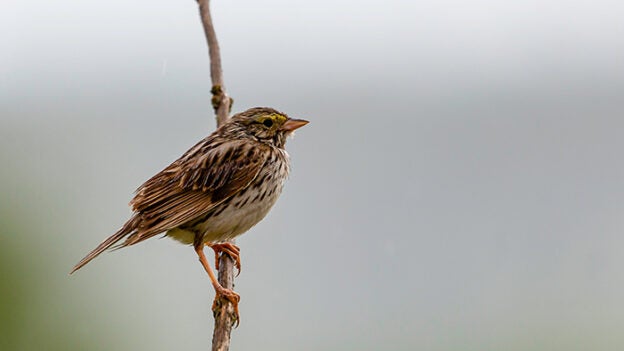
How do we in animal welfare balance the needs of cats and birds? Can that challenge only be met for birds at the expense of cats, or of cats at the expense of birds?
In one of the most-loved Million Cat Challenge webinars, Cats, Birds, and Animal Shelters, KSMP Director Dr. Kate Hurley sets out with an open mind to explore the experience of those on the front lines of cat management, investigate the science and research, and examine the role of “catch and kill,” eradication, TNR, confinement, and other approaches to community cat management and the welfare of birds and other wild animals.
What Dr. Hurley discovers may surprise cat and bird lovers alike. Luckily, cats vs. birds is one thing we don’t need to argue over this Thanksgiving—or any day. Instead, we can be grateful that we don’t have to choose between the welfare of cats and the welfare of birds. Community cat programs that practice spay/neuter and return to home for healthy, free-roaming cats are a win for shelters, a win for the public, a win for cats, and a win for birds and other animals.
Ch-ch-change is in the air and it’s not just the weather! Thank you to the hundreds of you that were able to attend this pair of webinars live last month. We were so inspired by the conversations that took place during and directly after the shows, and we’re even more invigorated by the messages that have been rolling into our inbox in the weeks that have followed.
Together we’re pushing ourselves to take a more critical look at the ideas, language and policies that leave us feeling like we’re spinning our wheels and, instead of feeling overwhelmed and defeated, we’re doing something about it!
Don’t get left out of the conversation: Watch this double feature and let us know how things are changing, or how you wish they could change, for the cats in your neck of the woods. We’re always here for a good cat chat.
Monica Frenden-Tarant, HSUS Senior Analyst, Cat Protection & Policy, Danielle Bays, and MCC co-founder Dr. Julie Levy gave great tips on how to match our storytelling to our mission when it comes to cats (Hint: those abundant cat overpopulation pyramid infographics aren’t doing us any favors, so think twice before you share them—according to mathematicians and scientists, an unaltered cat might have around 95 kittens over 7 years, not 370,092!).
In this webinar, Maddie’s Director of Feline Lifesaving Monica Frenden-Tarant joins UC Davis Koret Shelter Medicine Program Director Dr. Kate Hurley to talk about how we can work together to get #allthecats back home, whether home is outdoors or in and whether that cat is friendly or not.
Get clarity on all the acronyms we use to talk about community cat programs—RTF, RTH, TNR, SNR—and hear why the only term we really need is Return to Home.
Plus, learn how to enlist your community to help keep more cats alive and thriving and why indiscriminate impoundment of cats is not only harmful to the cats, but to marginalized communities.
From inviting us to check our language or redefine what home means, these two back-to-back cat-centered webinars are here to help us better serve cats in our communities. Pounce on the latest Million Cat Challenge webinar if you missed it and register for next week’s offering from HASS, What Home Means for Cats: Working Together to Keep More Cats Alive and Thriving, featuring Maddie’s Director of Feline Lifesaving Monica Frenden-Tarant and UC Davis Koret Shelter Medicine Program Director Dr. Kate Hurley.
Last week in Language That Harms Cats, Monica Frenden-Tarant, HSUS Senior Analyst, Cat Protection & Policy, Danielle Bays and MCC co-founder Dr. Julie Levy gave great tips on how to match our storytelling to our mission when it comes to cats (Hint: those abundant cat overpopulation pyramid infographics aren’t doing us any favors, so think twice before you share them—according to mathematicians and scientists, an unaltered cat might have around 95 kittens over 7 years, not 370,092!). Watch the recording and head to Maddie’s Pet Forum for more Q&A.
The cat conversation continues next Tuesday, August 31 at 3 p.m. PT with What Home Means for Cats. In this live webinar, Monica Frenden-Tarant will join Dr. Kate Hurley to talk about how we can work together to get #allthecats back home, whether home is outdoors or in and whether that cat is friendly or not. Get clarity on all the acronyms we use to talk about community cat programs—RTF, RTH, TNR, SNR—and hear why the only term we really need is Return to Home. Plus, learn how to enlist your community to help keep more cats alive and thriving and why indiscriminate impoundment of cats is not only harmful to the cats, but to marginalized communities.
It’s at the heart of the work we do: getting animals back home. Over and over data confirms that both dogs and cats have a much higher chance of just that if reunification efforts are made in the neighborhoods where they are found, rather than after they’ve entered the shelter. And we know that the cycle of impounding and rehoming disproportionately impacts under-resourced and marginalized communities.
We’re getting clearer on what works and what doesn’t for people and animals, and it’s time to clarify our terminology too. When it comes to serving community cats who are thriving right where they’re at, the programming might be called TNR, SNR or RTF. It’s important our language matches our mission and our work, which is why we wholeheartedly support the shift to Return to Home, or RTH.
Return to Home may not be as easy as clicking your heels three times, but when we show up ready to learn from one another and our communities, we’ve got the collective brains, heart, and courage to make it happen. If you’re ready to explore all things possible with RTH, start with these recent must-sees:
The Top Ten: Questions and Controversy with Community Cat Programs
For community cats, the majority of whom are unowned, though not uncared for, home looks a little different: it might be curling up under a network of caregiver porches instead of at the foot of a bed. In this Million Cat Challenge webinar, Maddie’s Fund®Director of Feline Lifesaving Monica Frenden, HSUS Senior Analyst Danielle Bays and Stray Cat Alliance Executive Director Christi Metropole answer common questions you receive about returning cats and give tips on crafting messaging that aligns with our universally-held goal of managing feline populations.
What Happens to a Cat When You Put It Back?
In this special presentation for California Animal Shelter COVID Action Response (CASCAR), Brittany Sundell details how Idaho’s West Valley Humane Society RTH community cat program employs innovative, low-cost research (breakaway collars and student-piloted drones for the win!) to gather valuable data on Canyon County cats and not only ensure the best care and outcomes for local felines—with an RTH rate of 85.9%—but also strengthen bonds between the shelter and community.
https://vimeo.com/563810892/de3ed84755
Using Data to Get Dogs Home
In another recent CASCAR presentation, Tom Kremer breaks down the data behind his Frontiers article, “A New Web-Based Tool for RTO-Focused Animal Shelter Data Analysis,” leads viewers through a guided tour of the powerful and versatile tool, and explains how it enabled the team at Dallas Animal Services to document where dogs were coming from in the community and how far from home they were found in order to strengthen RTH efforts.
Are you considering launching, or have recently launched, a RTF/SNR/TNR program and are now dealing with an onslaught of questions and/or pushback from your community about why you’re putting cats/kittens back where they came from? Are you being accused of abandonment? Wreaking havoc on the environment, birds, gardens, peace AND quiet? Although it may not feel like it at times, you and your community share the same goal, and the June 25 webinar The Top Ten: Questions and Controversy with Community Cat Programs from Maddie’s Fund® and the Million Cat Challenge will help you build on this common ground.
Whether you identify as an animal welfare professional, a bird lover, someone who just wants these cats out of your yard, or all of the above, we’re all here for the most effective, sustainable way to reduce the number of cats living outside. Our challenge lies in communicating the benefits of a proven strategy that can often seem counterintuitive to those new to feline management.
An all-star panel featuring Monica Frenden (Maddie’s® Director of Feline Lifesaving), Danielle Bays (HSUS Senior Analyst, Cat Protection & Policy) and Christi Metropole (Executive Director of Stray Cat Alliance) will give answers to the top ten questions you receive about TNR, SNR, and returning cats, and let us know how to message community cat program alignment with our universally-held goal of managing feline populations.
Save the date and register here. Want to be sure your question is addressed? Email #allthecats@millioncatchallenge.org and we’ll queue it up for showtime.
Recently the National Animal Care & Control Association (NACA), a group representing officers responsible for public health and safety, issued a strong statement supporting humane community cat management and trap-neuter-return and advocating for continued community education.
The statement acknowledges that impoundment of healthy adult cats reduces the likelihood of reuniting families with pets while disproportionately impacting under-served and marginalized communities.
It is the position of NACA that indiscriminate pick up or admission of healthy, free-roaming cats, regardless of temperament, for any purpose other than TNR/SNR, fails to serve commonly held goals of community animal management and protection programs and, as such, is a misuse of time and public funds and should be avoided.
A concerned or frustrated community member arrives at the shelter with a lost cat they found hanging around the neighborhood. Traditionally shelters have accepted that cat into their care and, when possible, put it on the path to adoption. That may well be the response the community expects. But what if that’s not actually in the best interest of the cat, lost or not?
On a recent episode of the Humane Network’s Shelter Success Simplified podcast, KSMP director Dr. Kate Hurley explains why returning a cat to home often means returning a cat to its community.
Cats are 10 to 50 times more likely to be reunited with their families if they are in the area of their original home rather than at a shelter.
Many times some quick research reveals the cat is already being loved and cared for by someone in the community. Scan the cat for a microchip. Encourage the finder to talk with neighbors, post about the cat on Nextdoor or look for lost-pet posts on Facebook.
Recognize that cats are disproportionately brought to the shelter from underserved communities. Look for opportunities to build community trust and provide pet caregivers with support and resources, such as pet food, vaccinations or spay/neuter.
For more tips on adapting your shelter’s approach to healthy, free-roaming cats, listen to the full conversation below and explore the library of other Shelter Success Simplified episodes at Humane Network.