
Shelter Learniverse and Industry-Wide Calendar

Category: Data Trends

  • Shrinking Denominators on Your Way to World Domination: When a Lower Live Release Rate Is Worth Celebrating

    Shrinking Denominators on Your Way to World Domination: When a Lower Live Release Rate Is Worth Celebrating

    You ask, we answer! We’re opening our mailbag (okay, our inbox) and getting curious about shelters’ most-asked questions. What’s on your mind? Email your question to sheltermedicine@ucdavis.edu.

    We are managing intake by offering a safety net program for owner surrenders, practicing return to home for healthy community cats, and taking in only the animals that really need us—often they require vet care. Because of this, our live release rate has dropped below 90%. Some of us are worried about what the community might think. Are we doing this wrong? — Worried But Optimistic

    Dear Worried But Optimistic, 

    My first reaction: Congratulations! This is what we expect to happen when we provide the right care, in the right place and at the right time, to the right outcome for each animal, and it’s our hope that every person working in a shelter will be able to join you in doing just that. Inspired by human healthcare initiatives, this Four Rights framework is designed to ensure the unique needs of each animal are considered with curiosity and compassion. In this context, a lower live release rate might feel scary at first, but it’s actually a measure of what’s going right: animals are getting the individualized care they need. Here’s why. 

    The story behind the numbers

    As we actively determine the animals who are best helped with shelter intake, our in-shelter population changes dramatically. Presumably, euthanasia is the right outcome for many of these animals as they are sick and/or injured, or dangerous. So while the number of euthanasias is likely to stay the same and possibly even decrease, the percentage of animals euthanized will increase. This is just math: the same number or even a smaller number of a smaller whole will result in a higher percentage.   

    The 90% live release rate benchmark assumes an estimated 10% of all animals entering the shelter will require euthanasia as the right outcome, but this doesn’t fully take into account our shift to a community-based sheltering model, where many animals are helped where they are instead of entering the shelter in the first place. Based on the compilation of the population actually entering the shelter, it makes sense that the percentage of animals for whom euthanasia is the right outcome would be much higher.  

    We should also consider how many animals are best served by not entering the shelter—how many pets stay with their guardians because of safety net programs like Project Home, or how many healthy community cats are returned to their neighborhoods and caregivers? In a sense, these animals are also part of our live release rate. When an animal doesn’t come in and thus doesn’t have to be euthanized, isn’t that just as good, if not better, than a traditional live release from the shelter? 

    When the stats aren’t telling your story, start talking!

    It’s important to track all animals we help—even if that help is a kind death to end irremediable suffering. This is the work we are called to do.  It’s also important to understand the data that we track and to be transparent about it. Believe and acknowledge that a decreased LRR as a percentage is a sign of success. When the stats look wrong but you’re on the right track, start talking to your community about why: It means that animals—and often their guardians too—are getting the help they need in new ways, including humane euthanasia when that is the right outcome. 

    Since your community might not speak animal welfare readily, offer examples they can connect with to demonstrate animals are still being served, just differently. This healthcare analogy might resonate: If you were to calculate the stats of everyone visiting the hospital on any given day—for example, all visits to the emergency room plus everyone visiting the nonemergency wing to get a Covid shot—you’d see most people who entered the hospital left alive. However, if you moved the Covid vaccinations offsite, you’d find your stats plummeted and, in fact, the number of deaths when compared to visits might be quite concerning. Not one extra life was taken by separating emergency services from nonemergency (in fact, all visitors benefitted from the resulting clarity, increased access to care, and convenience), but suddenly a different story is presented on the surface. If we fail to report our ER stats alongside what’s happening at our Covid vaccination sites, we’ve failed to tell our story. 

    Tell and show your community the stories behind the numbers, and invite everyone to celebrate with you. We will be! I have talked about this phenomenon in theory for years—and I’m really excited to see it happening in real time, so I’ll say it again: Congratulations!

    — Cindy

  • No Place Like Home: Why RTH Is Key

    No Place Like Home: Why RTH Is Key

    It’s at the heart of the work we do: getting animals back home. Over and over data confirms that both dogs and cats have a much higher chance of just that if reunification efforts are made in the neighborhoods where they are found, rather than after they’ve entered the shelter. And we know that the cycle of impounding and rehoming disproportionately impacts under-resourced and marginalized communities.

    We’re getting clearer on what works and what doesn’t for people and animals, and it’s time to clarify our terminology too. When it comes to serving community cats who are thriving right where they’re at, the programming might be called TNR, SNR or RTF. It’s important our language matches our mission and our work, which is why we wholeheartedly support the shift to Return to Home, or RTH.

    Return to Home may not be as easy as clicking your heels three times, but when we show up ready to learn from one another and our communities, we’ve got the collective brains, heart, and courage to make it happen. If you’re ready to explore all things possible with RTH, start with these recent must-sees:

    The Top Ten: Questions and Controversy with Community Cat Programs

    For community cats, the majority of whom are unowned, though not uncared for, home looks a little different: it might be curling up under a network of caregiver porches instead of at the foot of a bed. In this Million Cat Challenge webinar, Maddie’s Fund® Director of Feline Lifesaving Monica Frenden, HSUS Senior Analyst Danielle Bays and Stray Cat Alliance Executive Director Christi Metropole answer common questions you receive about returning cats and give tips on crafting messaging that aligns with our universally-held goal of managing feline populations.

    What Happens to a Cat When You Put It Back?

    In this special presentation for California Animal Shelter COVID Action Response (CASCAR), Brittany Sundell details how Idaho’s West Valley Humane Society RTH community cat program employs innovative, low-cost research (breakaway collars and student-piloted drones for the win!) to gather valuable data on Canyon County cats and not only ensure the best care and outcomes for local felines—with an RTH rate of 85.9%—but also strengthen bonds between the shelter and community.

    https://vimeo.com/563810892/de3ed84755

    Using Data to Get Dogs Home

    In another recent CASCAR presentation, Tom Kremer breaks down the data behind his Frontiers article, “A New Web-Based Tool for RTO-Focused Animal Shelter Data Analysis,” leads viewers through a guided tour of the powerful and versatile tool, and explains how it enabled the team at Dallas Animal Services to document where dogs were coming from in the community and how far from home they were found in order to strengthen RTH efforts.

    https://vimeo.com/571695815/fac49d9a92

  • What National RTO Averages are Not Telling us About Redemption.

    What National RTO Averages are Not Telling us About Redemption.

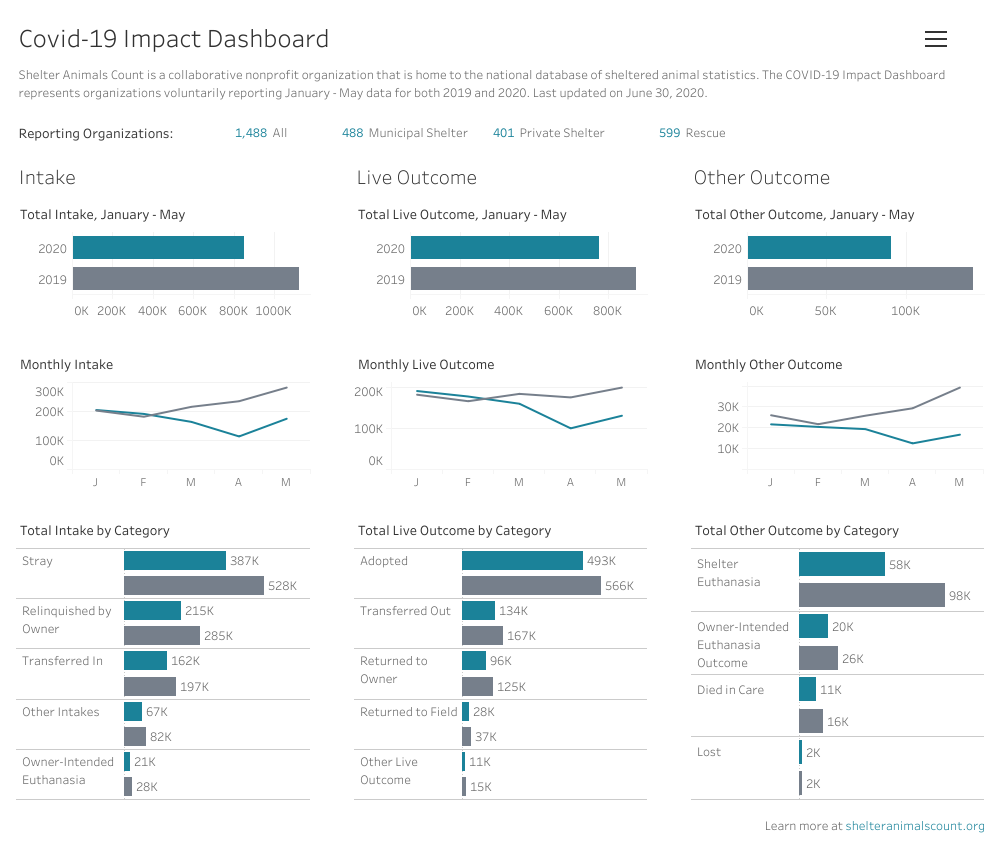
    According to the 2,760 organizations that report to Shelter Animals Count, national shelter intake is down over 25% for the first half of 2020; in some states, such as New York, animal intake is down as much as 55%.

    The stories behind these stats are good ones: Animals are being directly rehomed by their guardians; fosters are “failing” in love and keeping animals that would have entered the sheltering system; food, medical, and behavioral resources are being offered to keep animals in homes before resorting to surrender; flush with time, guardians are able to work through behavioral and environmental challenges. 

    With so many of our markers trending in a positive direction, why aren’t we finally seeing an uptick in the ever-stubborn Return to Owner (RTO)? One might predict that the reduction in intake might have allowed staff to reallocate time to redemption efforts that move animals through the shelter faster, but a quick glance at the data suggests that’s not the case. In fact, RTO is down 1% from 13.8% to 12.7% (cats and dogs combined). What the heck?

    Perhaps you intuitively know that doesn’t sound right. If you are one of the many shelters that have reduced your services to emergency-only during the pandemic, you’re likely attuned to the emerging data that has demonstrated a reduction in intake has not resulted in an increase in animals found dead on the street. So where are these animals going?
    We decided to call one of our own local shelters to dive deeper into what’s really going on with redemption rates.

    In Sacramento City, out of the 67 animals that were found from April 1-June 30 and whose finder used Front Street Animal Shelter’s text to report/find app,  22 animals returned to their owners without ever entering the shelter.  That’s 20% higher than the national average we are seeing reported by shelters. 

    “And that’s just the ones we know about.  Many people don’t follow up with the survey and report their success to our shelter, but we can see from the ones that have responded that animals are being returned to their owners at much higher rates than our national average,” reports Front Street director Phillip Zimmerman. “They’re using the recommendations we’re providing and they are locating guardians on their own before coming to the shelter, which means they aren’t showing up in our head count.” 

    Does your shelter have a way of tracking the animals that don’t enter your shelter but are served by members of your community? We’d love to hear the results! Email us at mnewkirk@ucdavis.edu if you have RTO rates- in and outside the shelter walls- to share. 

    Interested in learning more about improving your redemption rates?  A webinar featuring Return to Owner expert and innovator, Gina Knepp of Michelson Found Animals Foundation took place on June 29th. Gina reviewed the most recent best practices and recommendations from the national organization dedicated to getting more pets reunited with their owners. This special webinar was moderated by Michelson’s Matt Ulrich. Watch on-demand at: https://bit.ly/2BeiwBc