Shelter Learniverse and Industry-Wide Calendar

Blog

  • Webinar – 9/21/21 – Resource Guarding in Dogs: A Fear Free Approach – Fear Free

    Webinar – 9/21/21 – Resource Guarding in Dogs: A Fear Free Approach – Fear Free

    Resource guarding is a common problem in dogs with a wide variety of behavioral presentations. The condition is sometimes referred to as possessive aggression, and it poses a serious risk of injury when aggression is directed toward humans or other animals. Resource guarding can negatively affect the human-animal bond and the dog’s social relationship with other animals. In this webinar, Kenneth Martin, DVM, DACVB, will discuss prevention, establishing a diagnosis, and treatment recommendations.

    Attendees will learn:
    – How to provide dog owners with general recommendations for the prevention of resource guarding in dogs
    – Specific training exercises helpful for preventing and treating resource guarding in dogs
    – Behavior modification techniques and medications that can be helpful in treating possessive aggression

    Presenter Dr. Kenneth Martin is a Diplomate of the American College of Veterinary Behaviorists and a licensed practicing veterinarian in the state of Texas. He has been treating animal behavior disorders and training problems for over 20 years. Dr. Martin is a Fear Free Certified Elite Professional and a subject matter expert for Fear Free.

    Brought to you by our friends at Blue Buffalo.

    WEBSITE LINK:  https://fearfreepets.com/resources/webinars/

  • Webinar – 8/26/21 – Managing Chronic Pain in Cats Following P3 Amputation – Fear Free

    Webinar – 8/26/21 – Managing Chronic Pain in Cats Following P3 Amputation – Fear Free

    Cats’ paws and toes play a critical role in their lives. Sometimes, however, we see cats in our practices who have had their P3s amputated. These cats, no matter how carefully their surgeries were performed, are subjected to the same nervous system aberrations that occur in humans post-amputation, which can result in chronic maladaptive, neuropathic pain in up to 80% of patients.

    In this session, Robin Downing, DVM, MS, DAAPM, DACVSMR, CVPP, CCRP, will explore ways to “unwind” the peripheral and central sensitization that occurs in the wake of P3 amputation, both in the feet, and downstream from altered biomechanics.

    WEBSITE LINK:  https://fearfreepets.com/resources/webinars/

  • Webinar – 8/17/21 – Beyond Fences and Fences For Fido: Unchaining Dogs by Providing Support Services – HSUS

    Webinar – 8/17/21 – Beyond Fences and Fences For Fido: Unchaining Dogs by Providing Support Services – HSUS

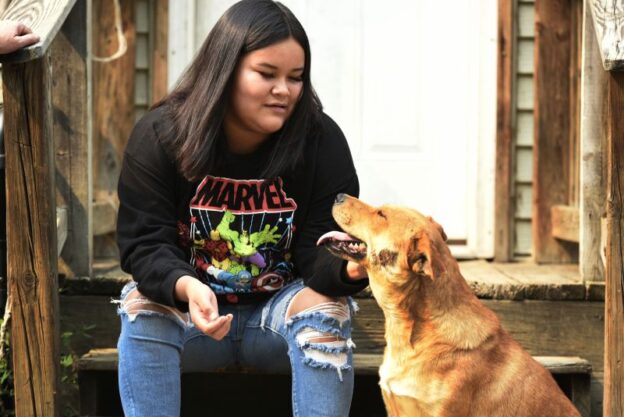
    Join HSUS’ Amanda Arrington (Director, Pets for Life) and Kelly Peterson (Oregon state director) to learn about their experiences co-founding Beyond Fences and Fences For Fido, respectively. You’ll learn about how these organizations have worked with families and provided alternatives to tethering for thousands of dogs in North Carolina and Oregon through fencing, veterinary care, and pet supplies at zero cost to the people and families with pets that are kept outside.

    This webinar will be at 1:00 pm ET, 12:00 p.m. CT.

    WEBSITE LINK:  https://humanepro.org/trainings/beyond-fences-and-fences-fido-unchaining-dogs-providing-support-services

  • New Edition of Infectious Disease Management in Animal Shelters Available in Paperback

    New Edition of Infectious Disease Management in Animal Shelters Available in Paperback

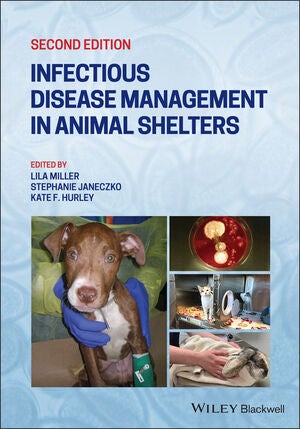
    Here’s a new release to add to your summer-and-beyond reading list: the revised second edition of Infectious Disease Management in Animal Shelters is now out in paperback, and it’s an essential resource for every shelter. Editors Dr. Lila Miller, former ASPCA Vice President of Shelter Medicine; Dr. Stephanie Janeczko, ASPCA Vice President of Shelter Medicine; and Dr. Kate Hurley, UC Davis Koret Shelter Medicine Program Director, have updated and expanded the first edition, published in 2009, to reflect advances in shelter medicine and best practices in preventing, managing and treating infectious diseases affecting cats, dogs and exotic small companion mammals in shelters.

    In the new edition, shelter veterinarians, managers and staff will find everything they need to help maintain animal health and wellbeing and improve outcomes:

    • Guidelines for general management and disease prevention and control in cats and dogs
    • Shelter medicine’s core principles of humane population management in the context of supporting shelters’ goals for preserving welfare, saving lives and protecting human health
    • A new chapter on exotic companion mammals
    • Practical strategies that draw on the latest research and evidence-based medicine and the authors’ personal experience in the field

    Though sheltering models have changed over the last twelve years, the focus on individual animal care and herd health is as foundational as ever. Successful disease management not only lowers euthanasia rates but also bolsters the very community-centered sheltering approach we are working toward. As Drs. Miller and Hurley note in their introduction, “the improved public confidence that a healthy population tends to generate can lead to greater support of the shelter, higher adoption rates, and an increased capacity to invest in programs to decrease shelter admission and keep pets healthy and safe with their families.”

    Infectious Disease Management in Animal Shelters, 2nd edition, is available to order online. Read the full introduction below. 

    [embeddoc url=”https://www.sheltermedportal.com/wp-content/uploads/2021/08/Introduction_Hurley-and-Miller.pdf” height=”800px” viewer=”google”]
  • Webinar – 8/10/21 – Struggle and Triumph in this Moment of Animal Welfare: An Inside Look from Pilot Shelter Directors – HASS

    Webinar – 8/10/21 – Struggle and Triumph in this Moment of Animal Welfare: An Inside Look from Pilot Shelter Directors – HASS

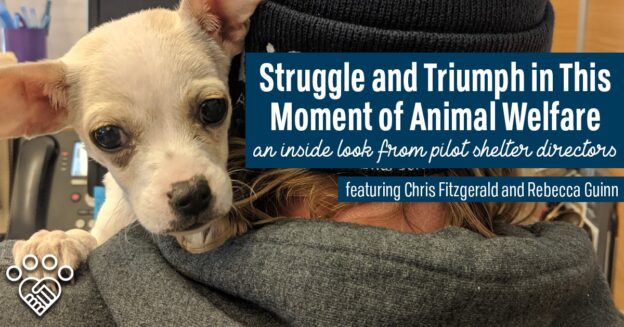
    The last year and a half has been one for the history books. In this moment of animal welfare, as intake numbers soar, people and pets are being evicted, and COVID is coming in another wave, there is struggle but there is also triumph. Join HASS Pilot Shelter Directors and members of the Managing Executive Committee, Chris Fitzgerald, Director of Rochester Animal Services, and Rebecca Guinn, CEO of LifeLine Animal Project, in a live webinar to discuss their wins and their losses. This webinar will be moderated by Maddie’s® American Pets Alive! Director, Kristen Hassen.

    WEBSITE LINK:  https://us02web.zoom.us/webinar/register/3316280110728/WN_-NhItPuDR7OmADRKVp8coA

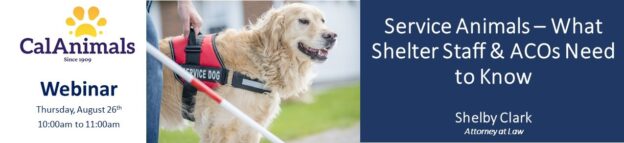
  • Webinar – 8/26/21 – Service Animals: What Shelter Staff & ACOs Need to Know – CalAnimals

    Webinar – 8/26/21 – Service Animals: What Shelter Staff & ACOs Need to Know – CalAnimals

    Attorney Shelby Clark will review what’s happening with federal laws, our state regulations, touch on local ordinances and share information about court decisions. This is an important topic and as animal welfare professionals working in shelters or in the field, the public expects us to have answers. Don’t miss out!

    WEBSITE LINK: https://www.calanimals.org/on

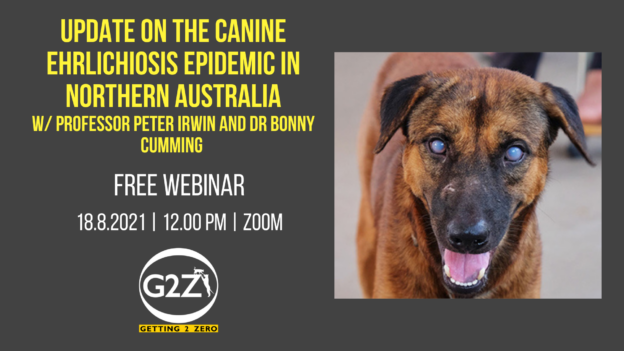
  • Webinar – 8/17/21 – Update on the Canine Ehrlichiosis epidemic in Northern Australia – Getting 2 Zero

    Webinar – 8/17/21 – Update on the Canine Ehrlichiosis epidemic in Northern Australia – Getting 2 Zero

    Canine ehrlichiosis is a serious, tick-transmitted disease of dogs. Until 2020 Australia was free of this disease due to stringent pre-import screening of dogs coming into Australia. Since its initial identification in northern WA, locally acquired cases have been diagnosed throughout the NT, northern WA and northern SA, with cases also identified in dogs travelling from these regions to NSW, Qld and Victoria. This presentation will provide some background to the disease and its vector tick, an update on the number of cases reported, the signs displayed by infected dogs, and the strategies needed to manage canine ehrlichiosis.

    Presenters

    Professor Peter Irwin, BVetMed, PhD, FANZCVS, MRCVS

    Peter graduated in veterinary science from the Royal Veterinary College, London University in 1982 and has a PhD from James Cook University (1991) for studies into canine babesiosis in Australia.  He is a Fellow of the Australian and New Zealand College of Veterinary Scientists (Canine Medicine). Peter has worked in academia in Australia and overseas for more than 25 years as a teacher of companion animal medicine and as a researcher in the fields of veterinary parasitology and medical microbiology. He is an internationally recognised expert in vector-borne diseases and is a director of the Vector- and Water Borne Pathogens Research Group(the Cryptick Laboratory) at Murdoch University.  His research concerns tick-borne infections of companion animals, wildlife and humans in Australia.  Peter is currently appointed  Emeritus Professor at Murdoch University.

    Dr Bonny Cumming – BVSc, MVS

    Bonny is a veterinarian and Program Manager -Strategic Delivery for Animal Management in Rural and Remote Indigenous Communities – a national not-for-profit organisation that coordinates veterinary and education programs in rural and remote Aboriginal and Torres Strait Islander communities.

    Bonny’s role with AMRRIC is diverse and includes establishing and managing strategic partnerships and projects, monitoring and evaluation, managing the development of the AMRRIC App, and policy and protocol development.

    For the last 13 months, Ehrlichiosis has been a huge part of Bonny’s role. On behalf of AMRRIC and the remote Indigenous communities that they service, Bonny has been raising awareness of the impacts of Ehrlichiosis to all levels of government, as well as relevant community-based stakeholders. Bonny has been leading the AMRRIC team to develop a range of education resources about this new disease, and is actively involved with ongoing government responses to this disease.

    WEBSITE LINK:  https://www.g2z.org.au/g2z-webinars-and-online-events.html

  • Webinar – 8/18/21 – Language That Harms Cats – MCC and Maddie’s Fund

    Webinar – 8/18/21 – Language That Harms Cats – MCC and Maddie’s Fund

    How we talk about cats can influence public attitudes and behavior, so it is important to consider the words, images and stories we use—particularly when we are trying to change the way the public views and responds to our work.

    Does the term “feral” hamper efforts to gain public support for community cat programs? How might your fundraising appeals accidentally create backlash against those same programs? In this fast-paced and thought-provoking webinar from Million Cat Challenge, we’ll see how we often talk about cats may actually be bad for them and make our work harder. We’ll have time after the webinar for discussion and figuring this out together. Plus, there may be bingo!  To play along, download the Bingo Card PDF and cut out one of the cards before the webcast!

    This webinar will be recorded.

    Presenters:
    Danielle Bays, Senior Analyst, Cat Protection & Policy, The Humane Society of the United States

    Monica Frenden-Tarant, Maddie’s Director of Feline Lifesaving, American Pets Alive!

    Dr. Julie Levy, Co-Founder, Million Cat Challenge, Maddie’s Shelter Medicine Program at University of Florida

    This webcast has been pre-approved for 1.00 hour of Certified Animal Welfare Administrator continuing education credits by the Association for Animal Welfare Advancement and continuing education credit by the National Animal Care & Control Association.

    WEBSITE LINK:  https://maddiesfund-org.zoom.us/webinar/register/WN_ThlK9FoqRJayZ8uhx6nk3g

  • California Budget Includes Money to Help Homeless Animals

    California Budget Includes Money to Help Homeless Animals

    UC Davis Koret Shelter Medicine Program to Administer Grants and Outreach

    California Gov. Gavin Newsom has signed budget legislation that includes $45 million in one-time support for a statewide Animal Shelter Assistance Program. The program will be administered by the Koret Shelter Medicine Program, at the University of California, Davis, Center for Companion Animal Health. The increase will be used to fund grants and outreach for the state’s animal shelters over a period of five years. The funding increase reflects the governor’s commitment to providing resources that can help communities realize the state’s long-held policy that “no adoptable or treatable animal should be euthanized.” Newsom tapped the Koret Shelter Medicine Program to set up a grant process, create and distribute educational materials and perform in-person consultations to help achieve the goals of the policy. He cited the program’s reputation for leadership in the field of shelter medicine and long history of working with California shelters. “This represents a promise fulfilled for animal shelters and communities, especially those that historically have been under-resourced. As the first academic shelter medicine program in the world, the Koret Shelter Medicine Program is well-positioned to provide the expertise required to earn the greatest return on this investment,” said Michael Kent, director of the Center for Companion Animal Health at the UC Davis School of Veterinary Medicine. A $5 million allotment for a two-year pilot project was funded in April. The $45 million augmentation restores the funding and longer timeline of the governor’s original proposal of $50 million over five years that was made in January of 2020. “We’re honored to be chosen to administer this pioneering program. This truly is a generational investment that has the potential to change the landscape for vulnerable animals and their families in California,” said Kate Hurley, founder and director of the Koret Shelter Medicine Program. “The additional $45 million allocation not only shows agencies throughout the state just like mine that our sacrifice and dedication is recognized, but also provides crucial fiscal support for programs essential to helping our communities rebuild from this devastating time,” said Cassie Heffington, animal services manager at Tulare County Animal Services. You can read more about the Animal Shelter Assistance Act. For a history of the governor’s original proposal, see Governor Newsom Proposes $50M Investment to Help California’s Homeless Animals and the California for All Dogs and Cats page at Sheltermedicine.com.

    We Want to Hear from You!

    What would you like to see in your shelter? Your state? Do you have ideas about how these one-time grant funds can not only help shelters that need support today but also build a roadmap that will advance and sustain California’s lifesaving in the future? Take a moment to tell us what interventions you think will set this program up for maximum impact. To be kept up-to-date about developments, please sign up for the California for All Dogs and Cats mailing list.
  • Conference – 10/6/21 to 10/9/21 – Wild West Vet 2021 – Vet Show (fee applies)

    Conference – 10/6/21 to 10/9/21 – Wild West Vet 2021 – Vet Show (fee applies)

    Gain up to 36 hours of CE while experiencing new adventures in Reno at Wild West Vet 2021! Enjoy the convenience and fun of learning and staying overnight at the grandiose Grand Sierra Resort and Casino. Meet veterinary professionals like yourself, build on your knowledge, and much more!

    WEBSITE LINK:  https://us.vetshow.com/wild-west-vet