
Shelter Learniverse and Industry-Wide Calendar

Blog

  • Webinar – 7/18/20 – What is a Veterinary Behaviorist and When Do I Need One? – Richmond SPCA ($20 fee applies)

    Webinar – 7/18/20 – What is a Veterinary Behaviorist and When Do I Need One? – Richmond SPCA ($20 fee applies)

    There are many pets who have trouble coping with certain situations or the world around them. These pets may be extremely anxious, act in an aggressive manner or develop compulsive behaviors.  It is essential to evaluate the emotional contributions to behaviors in order to  make a treatment plan that allows the pet to cope with life’s stressors.

    Have you ever wondered what a veterinary behaviorist does or why a pet would need to consult with one? Veterinary Behaviorists are licensed veterinarians that have achieved board-certification in the specialty of Veterinary Behavior. Pets of all types and ages may need help and we want you to know when to get them additional behavior assistance. This presentation will be beneficial for veterinarians, trainers, behavior consultants and many other pet professionals who work with a variety of animals.  Pet guardians may also find this information useful while pursuing help for pets displaying behavioral and emotional issues.

    CEU’s:
    CBCC-KA 1
    IAABC Lecture – 1
    RACE for veterinarians
    To submit CEU’s please contact Alisha Fritz at afritz@richmondspca.org.

    Topics covered will include:

    • What is a veterinary behaviorist? What specialized training have they received?
    • What can a veterinary behaviorist offer to clients that is different from a family practice vet?
    • What types of behaviors and symptoms indicate that an animal should be referred to a veterinary behaviorist?
    • How does a veterinary behaviorist work with veterinarians and trainers/behavior consultants?
    • What are examples of medical issues affecting behavior?
    • How do you find a veterinary behaviorist in your area?
    • What can you do when a client doesn’t have a veterinary behaviorist in their area or can’t afford these specialized services?
    • Time will be available for questions at the end of the webinar.

    Proceeds to benefit the Richmond SPCA.

    About Amy Learn, VMD
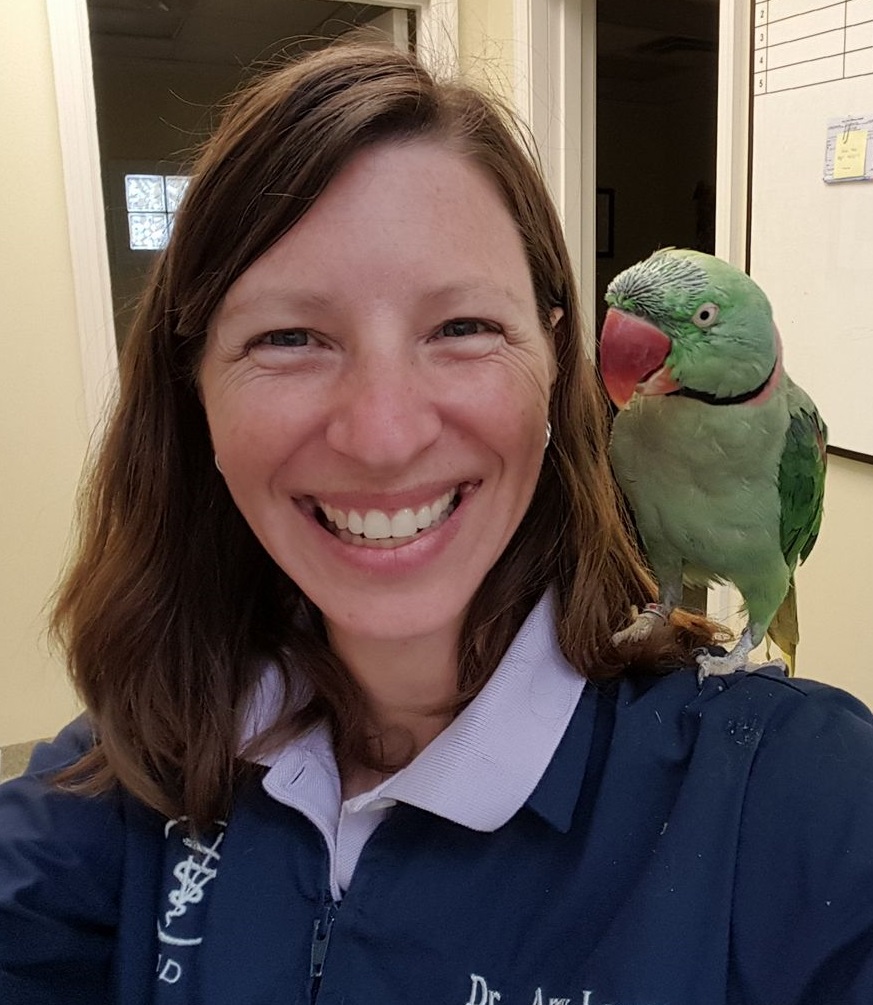


    Dr. Amy Learn is Chief of Medicine at the Animal Behavior Wellness Center’s Richmond location. Dr. Learn is in her last year of residency in Clinical Behavioral Medicine. She is currently co-mentored by Dr. Amy Pike and Dr. Lisa Radosta.

    She earned her Veterinariae Medicinae Doctoris from the University of Pennsylvania School of Veterinary Medicine in 2003. After graduating, she completed an internship in small animal medicine and surgery with rotations in medicine, surgery, ophthalmology, dentistry, general practice, emergency, oncology, dermatology, cardiology and neurology. She has been practicing general medicine for 15 years. Before deciding on a behavior residency, Dr. Learn had been pursuing surgery as a specialty. She ultimately realized that treating pets with behavior problems was her calling.

    ​Certifications, Affiliations and Awards:

    • Low Stress Handling – Certified Silver (2016)
    • Fear Free Certified Professional, Level 1 (2016)
    • Volunteer with Project Chimps (2016 – present)
    • Fear Free Certified Professional, Level 2 (2017)
    • Fear Free Certified Professional, Level 3 (2018)
    • R.K. Anderson ACVB Resident Award (2019)

    WEBSITE LINK:  https://richmondspca.org/classes/webinar-what-is-a-veterinary-behaviorist-saturday-7-18-at-400-p-m/

  • Webinar – 7/20/20 – The Future of Volunteers in Sheltering –

    Webinar – 7/20/20 – The Future of Volunteers in Sheltering –

    Volunteers and those who lead them are critical to the lifesaving work of animal shelters nationwide. The last few months have drastically changed how most organizations engage volunteers. As the Covid-19 pandemic spread across the country, animal shelters quickly shifted operations, moving animals into foster and—in most cases—asking the majority of volunteers to stay home. Many areas are now seeing increasing coronavirus infection rates as states struggle to move responsibly through various stages of re-opening.

    What does all this mean for the future of volunteers in sheltering? What role do volunteers play in ensuring our shelters are resilient and sustainable during these challenging times? How can volunteers help to ensure we re-emerge stronger than ever post Covid-19? Despite the difficulties ahead, there is significant opportunity to harness volunteer energy to strengthen shelters in meeting their lifesaving missions and better serve the animals and people in our communities.

    We invite leaders of volunteers, shelter managers, executive directors and others to join us for a series of robust discussions and breakout groups, to explore questions such as:

    • How is volunteer engagement evolving and changing in this new COVID world?
    • What challenges are we facing and how might we overcome them?
    • What opportunities might we seize upon to engage volunteers in new strategic ways to reach our goals?
    • How do we ensure our shelters’ volunteer efforts are resilient and sustainable to meet the needs of the animals in our care and the communities we serve long into the future?

    Monday, July 20, 2020
    2:00pm – 4:00pm ET, 11:00am – 12:00pm PT

    Register for the Zoom session:

    Facilitators:

    Betsy McFarland
    Betsy is a collaborator and bridge-builder with a proven track record of navigating diverse viewpoints, often in emotionally charged situations. She is skilled at gathering input and synthesizing it to identify common ground and implement innovative solutions. She is a trained facilitator, with an Executive Certificate in Facilitation through Georgetown University’s Institute for Transformational Leadership. Passionate about engaging the community, Betsy also has extensive experience growing volunteers within organizations large and small. She specializes in providing training and assessments in effective volunteer engagement and guides organizations through strategy development to ensure program effectiveness at all levels. Betsy is a Certified Animal Welfare Administrator (CAWA) through the Association of Animal Welfare Advancement (AAWA) and holds a degree in psychology from George Mason University.

    Lydia Krupinski
    Lydia is the Vice President of Mission Impact where she oversees The Anti-Cruelty Society’s humane education, community outreach, volunteer, and adoption placement efforts. As the Society’s Chief Program Officer, Lydia is leading the charge in expanding the organization’s community of caring by supporting and inspiring animal lovers within and beyond the walls of the organization. Whether it’s facilitating adoption matches, equipping fosters and volunteers, responding to community pet needs, or mentoring the next generation of animal advocates, Lydia and her team are meaningfully engaging the public in exciting and innovative ways.

    Betsy and Lydia will be joined by Adisa team members Laura Maloney, Heather Cammisa and Jyothi Robertson.

    Laura Maloney
    Laura specializes in executive and leadership development, team and organizational effectiveness, and aligning organizations to deliver its strategy. She has a special interest in expanding the capacity of leaders to build thriving enterprises and high-performance teams and has served as the CEO of a multi-million-dollar organization to COO roles at highly regarded national and global mission-focused organizations operating in 50 countries. Laura holds certifications in Executive Coaching, Change Leadership, Applied Neuroscience and is a certified administrator of The Leadership Circle 360 Assessment with advanced training in vertical development and compassion fatigue. She is a member of Forbes Coaches Council and the International Coaching Federation, serves on the board of Gorilla Rehabilitation and Conservation Education (GRACE) Center in the Democratic Republic of Congo, and is a strategic advisor to the International Rhino Foundation.

    Heather Cammisa
    Heather has two decades of experience serving in leadership roles at not for profit organizations, including more than a dozen years as chief executive officer leading excellence in strategy, program development, fundraising, fiscal management, communications, relationship building, legislative affairs, board relations and broad cause advocacy. She has worked with national, regional and local entities. She is a popular speaker at regional and national conferences in addition to being a trusted colleague to companion animal, wildlife and farmed animal advocate organizations. She is a Certified Animal Welfare Administrator (CAWA), trained disaster responder, Animal Control Officer (ACO) and Animal Cruelty investigator (ACI). Heather holds a Master’s Degree in Economics from Rutgers University and worked in both financial and social economics before devoting her career to not for profit management and cause advancement.

    Jyothi Robertson is a veterinarian who specializes in organizations that manage animals in human care. Her expertise as a veterinarian and shelter medicine specialist over the past thirteen years has led to her focus on the creation of efficient processes, improving organizational structure, and enriched facility design to minimize animal stress and improve overall animal health and well-being. Dr. Robertson has extensive board and management experience, which she brings to her work in improving productivity for organizations. She serves on multiple boards such as Executive Board of the Association of Shelter Veterinarians (ASV) Management, Subcommittee for the national Animal Welfare Committee (AWC) for the American Veterinary Medical Association (AVMA), Delegate in the House of Delegates for the California Veterinary Medical Association.

  • Webinar – 7/30/20 – Shelter Behavior Roundtable: Behavioral Support for Fosters- ASPCAPro

    Webinar – 7/30/20 – Shelter Behavior Roundtable: Behavioral Support for Fosters- ASPCAPro

    With the increase in fostering during COVID-19 shut-downs, you may be looking for resources to help your agency better support your foster volunteers. Join the ASPCA Learning Lab and colleagues in the field for a roundtable discussion where your questions will be answered via live Q&A. During this interactive session, you’ll engage with sheltering experts on methods to increase your capacity to provide behavioral support to foster families.


    Takeaways

    • Tactics for managing animals’ behavioral needs in foster homes
    • Strategies to educate and support foster volunteers
    • Tips for increasing your behavioral healthcare capacity

    Suited For

    Animal behavior and shelter professionals

    ABOUT THE PRESENTERS:


    marny nofi

    Marny Nofi

    Marny oversees the feline behavior and enrichment program at the ASPCA’s Animal Recovery Center in Manhattan. Her specialty is rehabilitating undersocialized and fearful cats to get them ready for adoption. In addition, Marny provides behavioral expertise and humane animal handling and capture to departments across the ASPCA. Marny’s goal is to provide animals with a low-stress, enriching environment that allows them to express normal, healthy behavior and maintain a good quality of life in the shelter.


    tiff shao with her dog

    Tiff Shao

    Tiff is a CPDT-KA and has been at the HSWM for 5 years. She oversees an all-encompassing behavior program at the HSWM. Tiff is involved in shelter facing programs like enrichment, behavior modification, adoption consultations, and the Behavior Helpline. She also works with the community by leading group classes, puppy kindergarten, and private lessons. Tiff has worked with issues as far ranging as reactivity, litterbox misuse, off leash skills, aggression, fear, and many others. She has found that solving behavior problems in the shelter provides a fountain of knowledge for community pet owners, and vice versa when addressing community pet challenges. Tiff has a soft spot for the “crazy dogs” and has helped with problem behaviors in police dogs and detection dogs. She lives with a 3 year old Dutch Shepherd who has taught her to always be on her toes.

    Katherine Good

    Kelly Adkins


    WEBSITE LINK:  REGISTER

  • Webinar – 7/15/20 – 5 Challenges to Managing a Veterinary Practice Post COVID-19 – Virox

    Webinar – 7/15/20 – 5 Challenges to Managing a Veterinary Practice Post COVID-19 – Virox

    WEBINAR: 5 Challenges to Managing A Veterinary Practice Post COVID-19​​​​​​​

    This 1-hour webinar, will be free, and funded by Virox Animal Health and will provide 1 hour of RACE accredited CE.

    By July, much of the North America’s shelter-in-place restrictions will be lifted and the full impact of the shutdown will come more clearly into view.Veterinary hospitals will try to return to business-as-usual, but a global recession, continued outbreaks of disease, employees unwilling to return to work, cash strapped clients, and lingering fears of social contact may make that an elusive goal.  Here is what practices should do to mitigate these five challenges and to reduce their impact on the business and  staff.


    About the Presenter

    Bash is a certified veterinary practice manager and a licensed veterinary technician in the U.S. He is a graduate of the College of William and Mary and the Veterinary Practice Management Program at Purdue University’s Krannert School of Management.  He has written for many industry publications including DVM360, Vetted, Veterinary Economics and AAHA Trends Magazine.  He frequently presents at veterinary conferences in the U.S., Canada, and the U.K.

    • Bash Halow, CVPM, LVT

      Webinar Host

    *This webinar is free, and will also provide 1 hour of RACE accredited CE.

    WEBSITE LINK:  Click Here

    Your friends,

    Virox Animal Health Team

  • Webinar – 7/21/20 – TechSoup Tour: How to Access Donations, Discounts, and Services – TechSoup

    Webinar – 7/21/20 – TechSoup Tour: How to Access Donations, Discounts, and Services – TechSoup

    Want to better understand how TechSoup can help your nonprofit organization?

    Join us for our webinar on how your organization can access TechSoup’s wide variety of product discount and donation programs. From hardware to software, we’ll give you a tour of the tools available to help your nonprofit with productivity, collaboration, financial management, donor tracking, security, and more.

     We’ll also show you how to access our many learning resources, tech services, courses, and community offerings designed to help you optimize technology for your organization.

     There will be plenty of time for Q&A, so be sure to bring your questions!

    Join us July 21.

    WEBSITE LINK:  Click Here

  • Webinar – 7/14/20 – Expanding Your Online Community with Web Accessibility – TechSoup

    Webinar – 7/14/20 – Expanding Your Online Community with Web Accessibility – TechSoup

    Donating, volunteering, and being involved in your community is for everyone … including those with disabilities.

    Inaccessible websites keep 15 percent of the population from finding you and your work online. That’s millions of potential patrons, volunteers, ambassadors, and even future donors who might not be able to use your website due to small but significant errors.

    In this presentation, Knowbility’s Jessica Looney and Jillian Fortin will cover

    • What accessibility is and why it should be a priority for nonprofits
    • The business case for accessibility
    • How to get buy-in from stakeholders of your organization
    • A few quick website techniques to make your site more accessible today

    Speakers

    Jessica Looney
    Jessica Looney, Director of Education, has worked for clients including Knowbility, Camp Fire USA, Austin Opera, The Thinkery and many others for nearly 20 years. Jessica has experience leading the organization, fundraising and marketing efforts for global outreach. Her work on tech-related programs includes rallying top talent to implement, teach, and advocate for accessible web design (AIR); organizing communities both locally and abroad to learn and practice accessibility (AccessU); and working to provide classroom support nationwide for students who use assistive technology (K-12 Access Toolkit). Jessica speaks at conferences and leads training workshops. Jessica has a degree in Nonprofit Administration from St. Edward’s University in Austin, TX.

    Jillian Fortin
    For more than a decade, Jillian Fortin has specialized in working with small to medium sized businesses as well as nonprofit organizations by helping them increase awareness of their brands online via search engines and social networks. She has traveled all over the country as a speaker on topics such as marketing through social networks, online brand management, universal design and accessibility. Previously, Jillian Fortin has managed web departments of up to 20 team members for online interactive marketing agencies and has held board positions for non-profit organizations in the Houston area.
    Jillian’s colorful background includes experience in a number of industries: she has worked in upper management as well as the arts, nonprofits as well as youth leadership councils. Her clients have ranged from the ages of four years old to eighty-four years old. She firmly believes in self-education and as a student of life, she plans on educating herself for as long as she can.

    WEBSITE LINK:  Click Here

  • Webinar – 7/8/20 – TechSoup Talks: Nonprofit Fundraising in the Age of Uncertainty – TechSoup

    Webinar – 7/8/20 – TechSoup Talks: Nonprofit Fundraising in the Age of Uncertainty – TechSoup

    In our next TechSoup Talks live-stream, we discuss five ways that nonprofit fundraisers can survive these tough times and emerge with positive approaches to donor engagement and fundraising.

    We’ll be speaking with nonprofit tech pro Michael Stein about how to engage your donor community as active partners through this time of uncertainty.

    WEBSITE LINK:  Click Here

  • What National RTO Averages are Not Telling us About Redemption.

    What National RTO Averages are Not Telling us About Redemption.

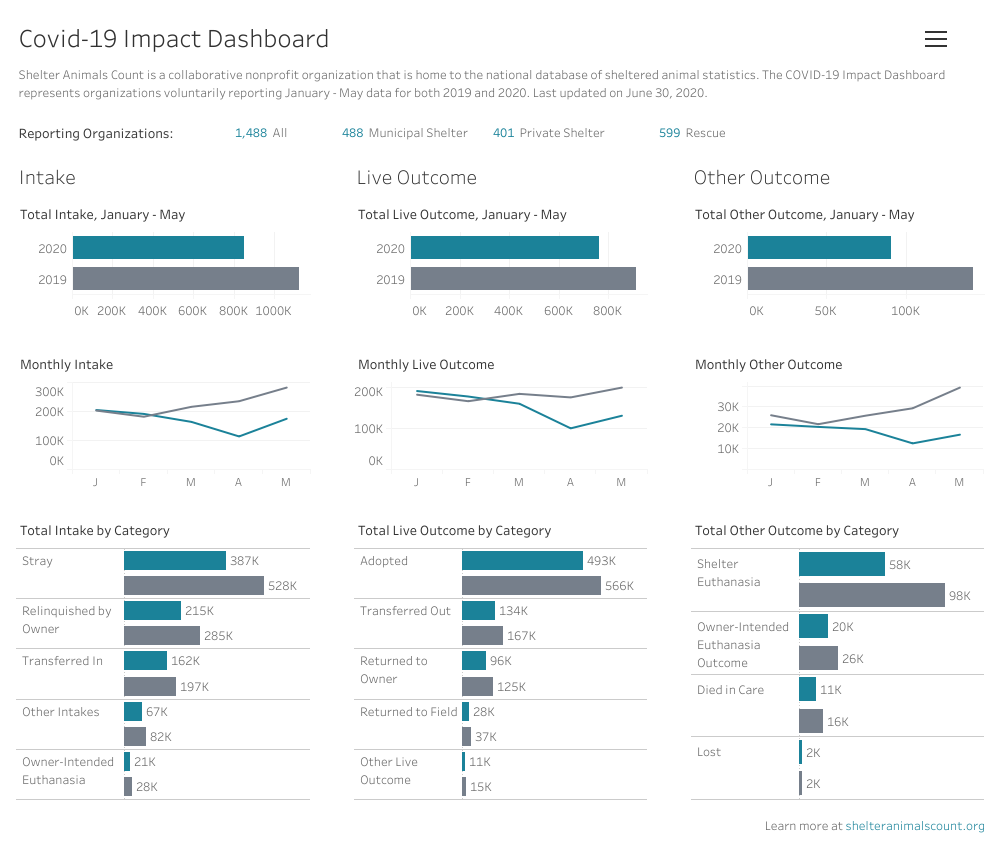
    According to the 2,760 organizations that report to Shelter Animals Count, national shelter intake is down over 25% for the first half of 2020; in some states, such as New York, animal intake is down as much as 55%.

    The stories behind these stats are good ones: Animals are being directly rehomed by their guardians; fosters are “failing” in love and keeping animals that would have entered the sheltering system; food, medical, and behavioral resources are being offered to keep animals in homes before resorting to surrender; flush with time, guardians are able to work through behavioral and environmental challenges. 

    With so many of our markers trending in a positive direction, why aren’t we finally seeing an uptick in the ever-stubborn Return to Owner (RTO)? One might predict that the reduction in intake might have allowed staff to reallocate time to redemption efforts that move animals through the shelter faster, but a quick glance at the data suggests that’s not the case. In fact, RTO is down 1% from 13.8% to 12.7% (cats and dogs combined). What the heck?

    Perhaps you intuitively know that doesn’t sound right. If you are one of the many shelters that have reduced your services to emergency-only during the pandemic, you’re likely attuned to the emerging data that has demonstrated a reduction in intake has not resulted in an increase in animals found dead on the street. So where are these animals going?
    We decided to call one of our own local shelters to dive deeper into what’s really going on with redemption rates.

    In Sacramento City, out of the 67 animals that were found from April 1-June 30 and whose finder used Front Street Animal Shelter’s text to report/find app,  22 animals returned to their owners without ever entering the shelter.  That’s 20% higher than the national average we are seeing reported by shelters. 

    “And that’s just the ones we know about.  Many people don’t follow up with the survey and report their success to our shelter, but we can see from the ones that have responded that animals are being returned to their owners at much higher rates than our national average,” reports Front Street director Phillip Zimmerman. “They’re using the recommendations we’re providing and they are locating guardians on their own before coming to the shelter, which means they aren’t showing up in our head count.” 

    Does your shelter have a way of tracking the animals that don’t enter your shelter but are served by members of your community? We’d love to hear the results! Email us at mnewkirk@ucdavis.edu if you have RTO rates- in and outside the shelter walls- to share. 

    Interested in learning more about improving your redemption rates?  A webinar featuring Return to Owner expert and innovator, Gina Knepp of Michelson Found Animals Foundation took place on June 29th. Gina reviewed the most recent best practices and recommendations from the national organization dedicated to getting more pets reunited with their owners. This special webinar was moderated by Michelson’s Matt Ulrich. Watch on-demand at: https://bit.ly/2BeiwBc

  • Webinar – 7/9/20 – How to Create a Remote Workforce Communication Plan for Your Nonprofit – TechSoup

    Webinar – 7/9/20 – How to Create a Remote Workforce Communication Plan for Your Nonprofit – TechSoup

    Remote work is exciting, fun, and different from office work. Getting into communication rhythms and making sure your team is performing well is not always easy. In this webinar, Adam Walker from the digital agency Sideways8 shares what he learned from running a company for 10years that never had an office. He’ll talk about how to think about remote work, the levels of communication to consider, and how to create a communications rhythm that will work for your team.

    Speaker

    Adam Walker, CMO at TechBridge & Co-Founder of 48in48

    Husband. Father of six. Wearer of fedoras. Startup co-founder (with exit). Nonprofit co-founder & CMO. Podcast host at Tech Talk Y’all and Real Pink.

    WEBSITE LINK:  https://globalmeetwebinar.webcasts.com/starthere.jsp?ei=1336071&tp_key=b9c6b26c80

  • Webinar – 7/9/20 – Chameleon Shelter Software – PetHarbor’s WebInterest – Chameleon

    Webinar – 7/9/20 – Chameleon Shelter Software – PetHarbor’s WebInterest – Chameleon

    WebInterest can connect you with potential adopters from PetHarbor.com, all with a click of a button. Well, that and a form they fill out. We send their information to you automatically, you save staff time and reach a wider audience.It’s also part of our support along with Pethealth of the Clear the Shelters Event, where we’re providing a dedicated pet adoption website for the event, and reporting for participating shelters on Chameleon and PetPoint.

    About Clear the Shelters

    NBC and Telemundo owned stations are teaming up with hundreds of shelters across the country to host Clear the Shelters, a nationwide pet adoption drive in August 2020 that helps find loving homes for animals in need. More than 411,000 pets have found their forever homes since 2015

    TAKE ME TO THE BEACH TO REGISTER NOW