Reactivity on the part of dogs living in shelters is a rampant issue that can contribute to behavioral deterioration, increased length of stay, and even loss of life. From a misdiagnosis of “aggression” to dogs whose reactive behavior escalates to problematic and potentially unsafe levels, learning how to help dogs suffering from reactivity issues is a crucial need shared by our entire industry.
While this webinar can be attended as a standalone course, we will build on our Fancy Footwork approach to handling and training to offer practical training, handling, and safety solutions to on-leash reactivity for dogs living in shelters.
This is a 1.5-hour presentation followed by a Q&A session. This webinar will NOT be recorded and is scheduled on EASTERN TIME.
While playgroups are the foundation of our shelter training program, teaching shelter teams how to implement a generalized, effective, and enjoyable way to handle and train their dogs is another essential aspect of our canine programming! In this webinar, we will teach the fundamentals of our “Fancy Footwork” techniques that focus on achieving good leash manners through the use of your FEET instead of your hands. Come learn this unique and highly effective approach that promotes dogs happily walking softly by your side, offering tons of eye contact, and wowing adopters! This new approach to leash work will enhance your handling skills and increase your ability to train ALL dogs, even those that are highly aroused, stressed, fearful, or not motivated by food, all in an effort to improve quality of life and lifesaving for dogs living in shelters.
Additionally, we will teach you how to implement our critically important kennel routines. The kennel areas of our nation’s shelters can be one of the most challenging and distressing environments that dogs–and their handlers–ever face. DPFL kennel routines have been developed and taught to shelters across the country in an effort to combat these challenges and to provide safer and more successful ways for dogs and people to maneuver through the kennels.
This is a 1.5-hour presentation followed by a Q&A session. This webinar will NOT be recorded and is scheduled on EASTERN TIME.
This webinar is intended to provide advice, interventions, and skills for individuals working with reactive or overexcited dogs. “The circle method of Loose Leash Walking” will be used to help the behavior and emotional state of reactive and over-aroused dogs by allowing them to adjust to their environment, reconnect with their handlers, and become more emotionally comfortable in the presence of specific triggers. The method can be used regardless of food interest and does not require elaborate set-ups. The information presented will build upon the circle method of loose leash walking, and will assume knowledge of that material. This webinar assumes professional or amateur trainers who can assimilate the information with a preexisting working knowledge of dog behavior, reactivity and over-aroused behavior.
Note: This webinar is back by popular demand. Please check your webinar library before purchasing to avoid duplicate purchases.
Society’s relationship to pets continues to evolve. The majority of people consider their pets to be beloved family members and expect their local animal shelter to work diligently to save the lives of the dogs and cats that enter the facility. This program will provide the knowledge you need to assume a management or leadership role at an open-admission animal shelter. You’ll learn how to maximize a shelter’s lifesaving potential through program management, community engagement, and shelter operations while at the same time preparing yourself for an exciting career.
The five courses are:
Leadership covering strategic planning, analyzing operations, decision-making, managing people and processes to achieve results, organizational responsibilities, and working with a board of directors.
Shelter Operations covering adoptions, animal care and sheltering fundamentals, animal behavior and enrichment, and customer service.
Community Program Development covering volunteers, foster care, spay/neuter, pet retention, events, and community relations.
Animal Health and Clinic Operations covering understanding shelter medicine, basic animal health considerations and care, euthanasia decisions, and clinic operations.
Marketing and Development covering development fundamentals, fundraising strategies, marketing fundamentals, adoption promotion, social media and websites, and media relations.
Each of these courses include live video conference sessions with top experts in the field providing students valuable contacts within the field. Additionally, alumni have access to exclusive networking opportunities and receive notification of employment opportunities.
You can sign up for individual courses or all five for a discount. All five must be completed to get a certificate.
Who will benefit from the program?
Professionals seeking a career change to something more personally fulfilling.
New shelter directors.
Shelter directors or managers wishing to improve their organization’s live release rate and sustainability.
People working in the animal welfare field who wish to advance into management roles.
Board members of animal shelters.
Credit for program/courses
Upon completion of all five courses, you will receive a Certificate in Animal Shelter Management from the University of the Pacific.
Each course earns:
Continuing Education Units (CEUs) from the University of the Pacific
Association of Animal Welfare Advancement CAWA Continuing Education (CE) credits
Schedule and Registration
Each of the five online courses are six weeks long and are offered sequentially. The entire program is about seven months long, and a new round starts again after a short break. More information on start dates of each course and the registration form can be found on the University of the Pacific website.
It’s back! Get ready for Our 7th Online Cat Conference.
Each year, the worldwide Community Cats Podcast community joins together at this unique virtual event—no travel required! During three comprehensive days of cat-centric content, speakers from a wide variety of roles in animal welfare will give you their perspective on the industry and valuable information that will help you or your organization create a more humane world for community cats.
Early bird registration is just $50 (increases to $75 in December so don’t wait!) and includes access to the live event and recorded sessions after the event, as well as speaker slides, handouts, and more.
#ThanksToMaddie we have several scholarships available for folks helping cats in the United States. If you would like a scholarship please fill out this short form below. Scholarships are limited.
The animal protection field is both incredibly rewarding and challenging. This webinar will discuss the causes and symptoms of compassion fatigue and provide a suite of skills for building and maintaining a healthy and intentional culture of skillful communication, openness, and personal responsibility.
Topics to be covered:
A shared language and understanding of the causes and symptoms of compassion fatigue
Skills that can be used to build and maintain a healthy and intentional culture
Communication, openness, and personal responsibility related to compassion fatigue
This webinar has been certified by the National Animal Care & Control Association and is approved for1 Continuing Education Unit. Please refer to your NACA membership portal for current CEU submission process. Current NACA Members who attend the live presentation or watch the recording will be able to download a jointly issued attendance certificate that includes the National Animal Care & Control Association logo. Visit the NACA training page for a complete list of future trainings.
About the Presenter:
Hilary Anne Hager is the Vice President of Outreach, Engagement and Training for the Humane Society of the United States. She has spent the last twenty years in the animal protection field, working at two different animal shelters, volunteering in wildlife rehabilitation, and as a member of the board of directors for several organizations, including a chimpanzee sanctuary, a “friends-of” nonprofit group supporting a municipal shelter, and a state federation of animal welfare organizations. She teaches compassion fatigue workshops around the country to help provide members of the animal protection community the support and resources to maintain their own well-being while working in a challenging and emotionally-charged environment. Hilary holds a master’s degree in Nonprofit Leadership from Seattle University.
What to do about canine dental health is one of the hottest topics in accessible veterinary care today. While everyone agrees that all dogs would benefit from regular dental procedures, the cost of dental care (including digital dental radiography) is well beyond the reach of many pet owners. Many shelter and community clinics provide some dental care to patients but often do so with guilt and conflict about not being able to provide the extensive care needed (or even worry about practicing below the perceived standard of care).
In this webinar, we will present results from an ASPCA-funded study that investigated the impact of dental cleaning on the quality of life of canine patients. Additionally, we investigated how an empirical treatment plan (pulling any obvious loose or severely diseased teeth) compared to recommendations made from a blinded radiograph review. Finally, we documented the incidence of retained roots for dogs who had extractions and followed these dogs forward in time for 6 months. This project aimed to answer the question of whether or not providing some care was better than providing no care for patients with end-stage canine dental disease. As many dogs ideally need dental procedures as often as every year, it is essential to come up with an affordable approach.
Takeaways
Understand current controversies around canine dental care.
Be able to describe strategies to make dentistry procedures more efficient.
Discuss improving communication around dental care using spectrum of care approaches.
Credits
This program has been RACE approved for 1 hour of continuing education credit in jurisdictions that recognize RACE approval.
Camp Maddie is a new learning series beginning with a virtual half-day foster edition on Thursday, December 7, 9am-1 pm PT (12 pm-4 pm ET). At Camp Maddie, we will cover various topics in to-the-point presentations, panel discussions, strategy-sharing seminars, videos and question and answer sessions. The focus will be on recruiting foster caregivers for adult dogs. Presenters will discuss breaking down barriers in the foster field, how they recruit foster caregivers and provide insight into strategies they use to make fostering accessible in their communities.
Maddie’s Fund will also be giving $200 grants to (4) lucky participants who join us live at Camp Maddie: Foster Edition on 12/7!
Topics and featured programs include:
Dog Foster Recruitment Strategies that are Working Right Now
Low-Barrier Onboarding for High Community Engagement
Maximizing Placements through Collaboration at Operation Kindness
Expanding Foster Programs with Foster+ at Dallas Pets Alive!
Doggy Day Out Marketing Process at KC Pet Project
Foster Dog Social Events at Animal Welfare League of Arlington
Innovative Foster Caregiver Recruitment Techniques at Palm Valley Animal Society
Converting Pet Finders to Foster Caregivers at Austin Pets Alive!
and more!
Who should attend? Everyone is welcome! Camp Maddie is perfect for those interested or involved in existing foster care programs, foster coordinators, marketing, leadership and operations enthusiasts.
The University of Wisconsin Shelter Medicine Program is excited to announce the next installment of National Shelter Medicine Rounds!
National Rounds is a platform for discussion of current topics relevant to shelter medicine for continued learning and collaboration. While primarily intended or shelter veterinarians, others interested in shelter medicine are welcome to join; we believe everyone will take something away from these calls! The national rounds call will take place Tuesday, November 14 from 2:30 to 3:30 Central Time.
As discussed during our rounds conversation in August, if we really want to change the experiences of the animals and the people we serve, we need to think outside our shelter walls or the foster homes that make up our rescues.
Join us for a continuation of the discussion on the connection between equity, well-being, resources, and capacity.
We are grateful to have two guests join us for rounds next week. Angela Rayburn is the Operations Manager overseeing Field Services at Chicago Animal Care and Control and AJ Caldwell is a National Shelter Support Specialist with Best Friends Animal Society and comes to that role with a background of being an officer in municipal animal control. They will share their perspectives on efforts to implement more positive, resource-based field services operations.
We hope to have an open discussion, so come with questions and feel free to unmute to participate! Our hope is to create a space that feels safe for all participants; we ask you to follow these Accountable Space guidelines. The presentation portion of National Rounds will be recorded, but the discussion and Q & A sessions will not.
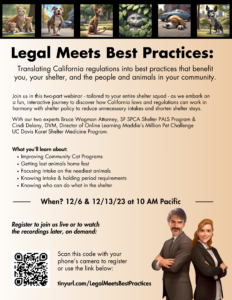
Legal Meets Best Practices: Translating California regulations into best practices that benefit you, your shelter, and the people and animals in your community.
Part 1 – December 6, 2023 – 10 AM to 11:30 AM Pacific
Part 2 – December 13, 2023 – 10 AM to 11:30 AM Pacific
Join us in this two-part series as we embark on a fun, interactive journey to demystify California’s legal landscape and discover how California laws and regulations can work in harmony with shelter policy to reduce unnecessary intakes and shorten shelter stays.
In this series, we will cut through the legalese, distill key takeaways, and provide you with practical, “what does this mean for me and my work?” guidance. If your shelter squad only ever attends one webinar series about how legal guidelines can be used to your advantage, let this be the one.
At the end of this series, you’ll understand how California laws and regulations should impact and inform best practices in how your shelter approaches critical areas including:
Improving Community Cat Programs
Getting lost animals home fast
Focusing intake on the neediest animals
Knowing intake & holding period requirements
Knowing who can do what in the shelter
Powered by partnership. This webinar is brought to you by the Maddie’sⓇ Million Pet Challenge Learniverse at the UC Davis Koret Shelter Medicine Program, San Francisco SPCA’s Shelter PALS program, and CalAnimals. By sharing our diverse expertise and working together to find the intersections where California law impacts animal shelters, we’ve formulated holistic shelter practices that allow you to better leverage the law.
Want to invite others to this webinar?
Download, print, and share this flyer and post it at your shelter to invite other staff members!