
Join Ken Ramirez, KPCT’s Chief Training Officer, for a free virtual event live from The Ranch on Thursday, June 3, at 12:00 pm (PT). Ken will be joined by Emma Parsons to demonstrate new techniques from the Click to Calm protocol and show how they can be applied to all dogs, whether they are reactive, shy, or just easily excited. Then, Ken and Clive D.L. Wynne, Ph.D. will explore his latest book and papers, including the efficacy of the clicker and dominance theory. The episode will include live training demos, audience Q & A, and so much more!
Blog
-
Webinar – 6/7/21 – MAC 2021 Webinar Series – The Future of Sheltering: Human Animal Support Services – Massachusetts Animal Coalition
What if there was a way animal welfare organizations could meaningfully address and solve the root causes of why animals enter shelters in the first place? The Human Animal Support Services (HASS) project is a collaborative effort of more than 500 animal welfare experts, 40 shelters and 36 working groups that are aiming to do just that. In the process, big lessons are being learned, revolutionary changes are happening, barriers in the community are broken down as the community becomes more involved – all allowing animals and people to stay together.
Learn about:
- The different components of HASS, how these components work to break down barriers making adoption, fostering, vet care etc accessible to all communities and how you can easily implement them in your organization.
- Proven strategies for reducing intake and housing more pets outside of the shelter.
- Embracing technology, repurposing staff, and accomplishing the HASS model without a lot of extra funding.
- Utilizing Volunteers in ways you never imagined to make all of this possible.
Speaker Information
Kristen Hassen is the Director of Maddie’s American Pets Alive!, overseeing the Maddie’s Academy, Human Animal Support Services, and other lifesaving initiatives. Kristen formerly served as the Director of Pima Animal Care Center, an open admission, government animal shelter in Tucson, Arizona with an intake of 20,000 animals annually and a live release rate of 93%. While at PACC, Kristen launched many of the Human Animal Support Services initiatives, including building the nation’s largest municipal shelter foster program, with 5,500 pets going to foster care annually. Before that, Kristen served as the Deputy Director at Austin Animal Center, in Austin, Texas and the Assistant Director at Fairfax County Animal Shelter in Fairfax, Virginia.
WEBSITE LINK: http://events.constantcontact.com/register/event?llr=dmv5lydab&oeidk=a07ehw9aaoj0f484258
-

How to Decrease Decibels and Decrease Stress
Close your eyes for a minute. What do you hear? Maybe birds chirping, a gentle breeze rustling leaves, a happy cat purring. Or, more realistically, phones ringing, doors slamming, the clang of dishes being cleaned, trash bins being emptied, and the persistent hum of the people around you. Which soundtrack puts you at ease, and which makes you want to pull your hair out (or, if you’re a cat, squeeze into the corner of your hidebox)? Noise levels affect our mood and well-being, and of course the same is true for shelter animals, with a little added pressure: Eat well, get good sleep, and put your best self forward for potential adopters!
If we want to improve animals’ health and well-being while they’re in the shelter and give them the best chance at finding a home, we need to think beyond optimizing cages and kennels to optimizing the rest of the shelter environment, and University of British Columbia researcher Bailey Eagan has some helpful tips on where to start. Based on data gathered at the British Columbia SPCA, Bailey and her fellow researchers found cats exhibited more fear behavior when noise levels in the shelter were highest and more maintenance behavior like eating or grooming when sound levels were lowest, and that, overall, sound affects behavior and likely also cat welfare and should be controlled as much as possible.
Lower the Volume on a Budget
Yes, you can decrease decibels on a budget! Follow Bailey’s practical advice below for reducing four common sources of shelter noise.
 Opening and closing doors and cupboards
Budget fix: Use silicone or felt pads and line doors with weather-stripping tape. Try to keep doors closed when possible, which helps create a noise barrier.
Splurge: Spring for a commercial door closer.
2
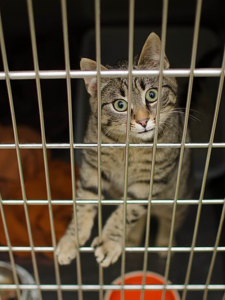 Stainless steel enclosures rattle when opened or closed
Budget fix: Add Plasti Dip coating to areas where metal meets metal, which can decrease sound by as much as 60 decibels.
Splurge: Install a ShorLine Quiet-Closing Latch.
3
Cleaning and filling metal food dishes
 Budget fix: Replace metal dishes with rubber-coated dishes or place a towel under the dish.
4
Filling and transporting garbage bins
 Budget fix: Place a foam pad between the bottom of the garbage bag and the bin and use a quiet dolly to move bins around.
Though cats are especially sensitive to environmental stress, minimizing noise levels is good for dogs and humans too. Bailey points out that while hearing damage begins with prolonged exposure to sound measured at 70 decibels for humans and 100 decibels for dogs, noise levels in animal shelters can reach up to 120 decibels.
For more tips on measuring and minimizing sound in your facility and the importance of preserving some peace and quiet for animals as shelters open back up—and an impactful demonstration of just how loud routine shelter activities can get—watch Bailey’s fascinating presentation to CASCAR, the California Animal Shelter COVID Action Response group (presentation slides available here).
-

Online Event – 5/25/21 – Maddie’s® Candid Conversations Series – Dr. Jyothi V. Robertson, Shelter Strategies – Maddie’s Fund
Join us for an open, informal 30-minute conversation and Q+A with Dr. Jyothi V. Robertson, President and Founder of JVR Shelter Strategies.
In this discussion with Maddie’s Fund Executive Leadership Team member Mary Ippoliti-Smith, Dr. Robertson postulates how different fields (environment, education, etc.) are interwoven, and that relying on an animal-centric focus keeps us from examining some of the systemic, root causes of the issues we face. Bringing new conversations to animal welfare can lead to more diversity, inclusion, equity that will offer a fresh perspective on how an individual may face multiple types of overlapping discrimination and how that affects our work and success.
Afterwards, continue the conversation with Dr. Robertson on Maddie’s Pet Forum.
WEBSITE LINK: https://maddiesfund-org.zoom.us/meeting/register/tZYscu-qrj0oHdTfvmmzypVmIwzFVQ39Ak78
-
Conference – 9/10/21 to 9/12/21 – Midwest Animal Sheltering Conference – Missouri Coalition of Animal Care Organizations
Join Missouri Coalition of Animal Care Organizations for the Midwest’s annual conference designed exclusively for animal rescues and shelters. Whether you’re a rescue volunteer, executive director, foster coordinator, or shelter veterinarian, the conference offers sessions for all levels of engagement. Workshops and sessions feature nationally-renowned speakers that present on hot topics in animal sheltering and rescue. The conference offers an invaluable opportunity to network and form vital relationships with your colleagues that are facing the same challenges as you every day. We come together to celebrate your victories and to find solutions to common problems, because collectively we can save more lives and have happier animals while doing it.
DETAILS
The 2021 Midwest Animal Sheltering Conference will take place at Stoney Creek Conference Center in Columbia, MO on September 10-12, 2021. Hotel rooms will be available at Stoney Creek.
Full details at https://www.missourianimals.org/aboutmasc.SPONSORS
Please e-mail masc@missourianimals.org if your organization would like to sponsor or exhibit at the conference.WEBSITE LINK: https://fb.me/e/eprLstWuX
-

San Francisco SPCA Says Veterinary Telemedicine Should Be Here to Stay
Last summer California joined other states in temporarily allowing virtual vet visits via phone or videoconference—but only if the pet was already a patient. On May 3 the San Francisco SPCA filed a federal lawsuit challenging restrictions on veterinary telemedicine and aiming to make it possible post-pandemic.
The lawsuit argues that current limits on telemedicine restrict veterinarians and pet owners’ constitutional right to free speech, as well as a pet’s access to veterinary care.
“People can use telemedicine for themselves and their children, so why not for their pets?” asked Brandy Kuentzel, General Counsel at the San Francisco SPCA. “Telemedicine can be a vital tool to improve the lives of pets and the people who love them.”
Read the full press release below.
[embeddoc url=”https://www.sheltermedportal.com/wp-content/uploads/2021/05/Telemedicine-lawsuit-press-release.pdf” height=”800px” viewer=”google”] -
Webinar – 5/13/21 – Preparing for Disasters: Review of the new CalAnimals Organizational Disaster Prep Checklist – CalAnimals
The CalAnimals Emergency Management Committee has created an organizational checklist to help your agency prepare for disasters that affect your community. This robust document offers a lot of great points for consideration and sample documents to assist you. Disaster preparedness experts Ryan Soulsby from Butte County Animal Control and John Peaveler from San Diego Humane Society are offering this webinar to walk us through it and answer your questions. A huge thanks to Hill’s Pet Nutrition for sponsoring this important resource!
WEBSITE LINK: https://us02web.zoom.us/webinar/register/WN_cmipkbukTnGCXVrp_y8RHg
-

Webinar – 6/16/21 – Befriending Your Grief: How to Cope with Euthanasia and Other Veterinary-Related Losses Time – HSVMA
Veterinary professionals often go into the field with a passion for animal welfare. One of the realities of the role is that we are faced with the death of the animals in our care, often multiple times daily, and in many cases, we assist in aiding end of life through euthanasia. While there has been a little more education and information provided to veterinary professionals on how to support animal owners through their grief, very little attention is paid to the grief veterinary professionals experience themselves. This program covers grief reactions related to the primary and secondary losses veterinary professionals experience every day.
This presentation will address the following objectives:
- Provide an understanding of grief and how it can manifest
- Provide an awareness of disenfranchised grief in the animal care profession
- Provide a discussion of the overlap of grief and compassion fatigue
- Provide ideas on how to cope with euthanasia and other veterinary-related losses based in theory
We hope you’ll join us for this important welfare-focused webinar. The webinar is open to all participants.
RACE CE will be provided FREE to current HSVMA members only.
If you are not yet an HSVMA member or need to renew your membership, please visit the HSVMA website HERE.PRESENTER: Sarina Manifold, LCSW

Sarina is a Licensed Clinical Social Worker (LCSW) in TN and NC, and Adjunct Professor with the University of Tennessee College of Social Work. Sarina previously worked at the University of Tennessee College of Veterinary Medicine for 10 years as one of the clinical social workers who provided grief support and crisis intervention to clients of the Small and Large Animal Hospitals and members of the community, provided counseling to UTCVM students and House Officers, and oversaw the communication training for UTCVM’s veterinary medical students.
She has moved to NC with her family and now owns a private practice where she continues to provide Veterinary Social Work services. Specifically she offers grief counseling for the loss of an animal, counseling to animal care professionals to help manage compassion fatigue, and consultation to the community for animal related issues. Sarina is also available to conduct presentations on the following topics: animal related grief & bereavement, supporting animal owners in emotional distress, compassion fatigue & self-care, and improving communication in veterinary teams.
She graduated from High Point University in High Point, NC with a Bachelor’s Degree in Psychology, and received her Master’s Degree in Social Work from the University of Tennessee.
WEBSITE LINK: https://www.hsvma.org/webinar_befriending_grief
-

Online Conference – 10/22/21 to 10/24/21 – 2021 Annual Aggression in Dogs Conference – Loose Leash Academy (fee applies)
Are you encountering more reactive and aggressive dogs in your day to day work? Do you have a dog who needs more help with aggressive or reactive behaviors? Would you like to learn from the best in dog training and behavior as they demonstrate their work with aggression cases? Join us for the Second Annual Conference dedicated to helping dogs with aggression.
WEBSITE LINK: https://thelooseleashacademy.com/aggression-in-dogs-conference
-

Webinar – 6/23/21 – Positive Puppy Socialization in Times of Restricted Real World Interactions – PPG (fee applies)
Puppy Essentials – Your Virtual and In-Person Guide to Early Socialization and Development – is a fun, interactive, training resource from DogNostics Education that can be used virtually to guide puppy owners through the first essential lessons. The focus of Puppy Essentials is socialization to situations, people, objects and other puppies; developing bite inhibition; preventing resource guarding; preventing separation anxiety; learning about canine communication and working with collaborative care skills.
Learning Objectives:
- Help educate your clients about the importance of socialization.
- Help your clients prevent resource-guarding issues.
- Help take the fear out of being alone.
- Teach clients to ‘speak dog.’
- Provide a guideline and suggested curriculum for virtual and in-person puppy socialization classes.
About Your Presenter
Louise Stapleton-Frappell – B.A. Hons, PCT- A, PCBC-A, CAP3, CTDI, DN-FSG2, DN-CPCT2, CWRI
Louise Stapleton-Frappell, Partner and Faculty Member of DogNostics Career Center and Board Member of The Pet Professional Guild, is a Professional Canine Trainer and Behavior Consultant – Accredited by The Pet Professional Accreditation Board. Louise has constantly built on her knowledge and furthered her education in the field of force-free, rewards based, science-based pet training. The creator of the DogNostics’ Dog Trainer Certification Program, Louise has presented at conferences internationally and has gained a reputation for expertly teaching and training humans and canines at her own establishment, The DogSmith of Estepona, in Southern Spain, where she offers a wide range of both group and private classes and pet dog services.
CEUs: PPAB 1, CCPDT (pending), IAABC (pending), KPA (pending)
WEBSITE LINK: https://petprofessionalguild.com/event-4178734