
Shelter Learniverse and Industry-Wide Calendar

Blog

  • Online Conference – 3/24/26 to 3/26/26 – My Dog Is My Home Conference 2026 – My Dog Is My Home

    Online Conference – 3/24/26 to 3/26/26 – My Dog Is My Home Conference 2026 – My Dog Is My Home

    When a person loses their home, they experience trauma and grief. Their pet may be their sole source of love and support.

    For a person experiencing homelessness, losing their pet can make one of the most difficult times in their life even more painful. Yet, with few emergency facilities offering pet-inclusive housing, it’s a decision so many people feel forced to make. We know pet-inclusive solutions to homelessness are not only possible, they already exist.

    Since 2021, we have hosted the annual My Dog Is My Home Conference with the hope that someday, nobody will have to choose between a home and their best friend. By showcasing emerging practices in keeping people and pets together, we are building the housing solutions and communities we want.

    The 3-day virtual My Dog Is My Home Conference (Mar 24-26, 2026) brings together:

    • Leaders in the field of pet-inclusive housing
    • Individuals with lived experience of homelessness
    • Hundreds of representatives from human services and animal welfare nonprofits

    The My Dog Is My Home Conference aims to increase access to pet-inclusive emergency and long-term housing through workshops, webinars, stories of lived experience, art, community networking, and more.

    All of this happens online, so there are no associated expenses beyond registration.

    A win-win-win for people, animals, and service providers—pet-inclusive housing:

    • Supports humans’ mental, emotional and physical health
    • Saves hard-to-adopt animals from languishing or being euthanized in shelters
    • Frees space in animal shelters that are beyond their capacity

    This year’s presenters include:

    • Aimee Gilbreath, President, PetSmart Charities
    • Nicholas Weinmeister, Project Administrator, USC Homelessness Policy Research Institute
    • Noah Patton, Director of Disaster Recovery Housing, National Low Income Housing Coalition

    Need financial assistance? We believe cost should never be a barrier to participation. You can apply today for a scholarship. Made possible by a generous sponsorship from Maddie’s Fund®, #ThanksToMaddie.

    REGISTER NOW:  https://www.mydogismyhome.org/2026-conference
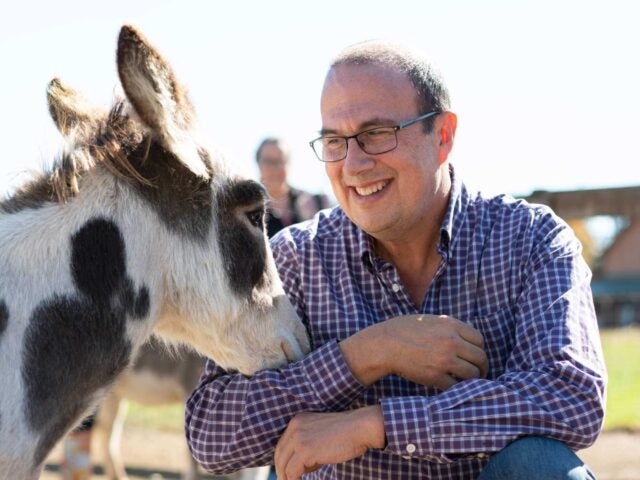
  • Online Event – 3/5/26 – Live from the Ranch: How Behavior Works  – Karen Pryor Academy

    Online Event – 3/5/26 – Live from the Ranch: How Behavior Works – Karen Pryor Academy

    About How Behavior Works with Susan G. Friedman, Ph.D. & Ken Ramirez
    How does behavior really work, and what makes lasting behavior change possible? Understanding the science of behavior change reveals how and why behaviors shift, allowing us to apply evidence-based principles that create lasting, meaningful, and effective change.

    Can’t tune in live? No worries! You can access the recording immediately after the broadcast.

    WEBSITE LINK:  https://learn.clickertraining.com/live-from-the-ranch#next

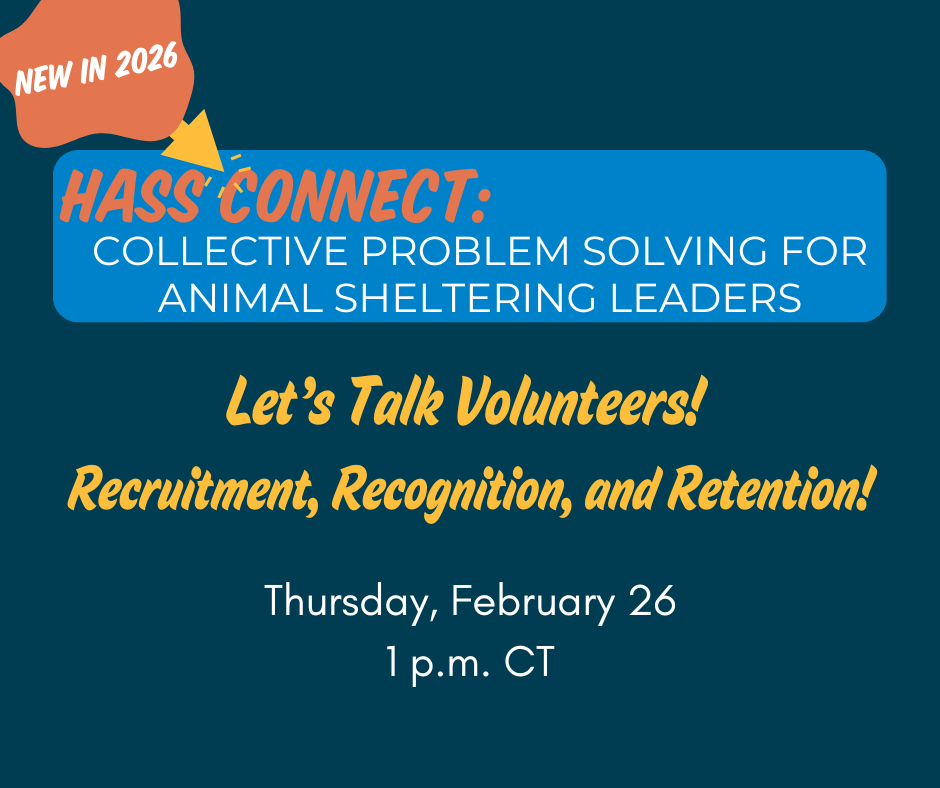
  • Webinar – 2/26/26 – HASS Connect: Let’s Talk Volunteers – HASS

    Webinar – 2/26/26 – HASS Connect: Let’s Talk Volunteers – HASS

    You are invited every fourth Thursday of the month, to join fellow leaders from national, government, and non-profit animal welfare organizations for a strategic roundtable discussion focused on the most pressing challenges facing our field. From staffing shortages and volunteer engagement to community trust, and the evolving role of shelters, this session invites candid dialogue, shared learning, and collaborative problem-solving. Whether you’re leading a municipal agency, nonprofit organization, or national initiative, your insights and experiences are vital to finding solutions.

    This month’s session will be discussing a topic we all can relate to – Volunteers! This will be an open discussion about recruitment, recognition, and retention. Hope to see you there!

    *You only need to register for the series once.

    Time: 1-2 p.m. CT

    Register here: https://zoom.us/meeting/register/eYjSHEXEQ–_PxoL4pH2_g#/registration

  • Webinar – Fourth Thursdays – HASS Connect – HASS

    Webinar – Fourth Thursdays – HASS Connect – HASS

    You are invited every fourth Thursday of the month, to join fellow leaders from national, government, and non-profit animal welfare organizations for a strategic roundtable discussion focused on the most pressing challenges facing our field. From staffing shortages and volunteer engagement to community trust, and the evolving role of shelters, this session invites candid dialogue, shared learning, and collaborative problem-solving. Whether you’re leading a municipal agency, nonprofit organization, or national initiative, your insights and experiences are vital to finding solutions.

    *You only need to register for the series once.

    Time: 1-2 p.m. CT

    Register here: https://zoom.us/meeting/register/eYjSHEXEQ–_PxoL4pH2_g#/registration

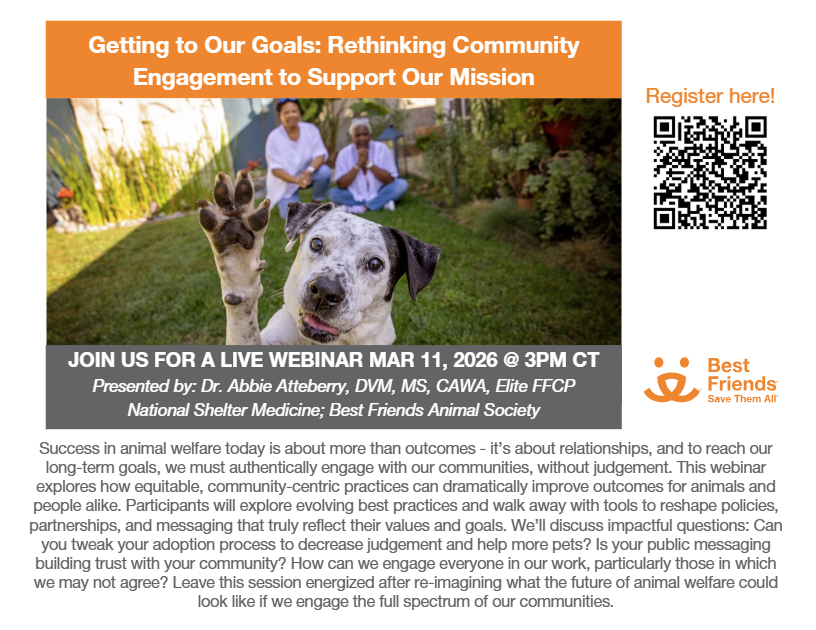
  • Webinar – 3/11/26 – Getting to Our Goals: Rethinking Community Engagement to Support Our Mission – Best Friends

    Webinar – 3/11/26 – Getting to Our Goals: Rethinking Community Engagement to Support Our Mission – Best Friends

    Success in animal welfare today is about more than outcomes—it’s about relationships, and to reach our long-term goals, we must authentically engage with our communities, without judgement. This webinar explores how equitable, community-centric practices can dramatically improve outcomes for animals and people alike. Participants will explore evolving best practices and walk away with tools to reshape policies, partnerships, and messaging that truly reflect their values and goals. We’ll discuss impactful questions: Can you tweak your adoption process to decrease judgement and help more pets? Is your public messaging building trust with your community? How can we engage everyone in our work, particularly those in which we may not agree? Leave this session energized after re-imagining what the future of animal welfare could look like if we engage the full spectrum of our communities.

    Presented by: Dr. Abbie Atteberry DVM, MS, CAWA, Elite FFCP
    National Shelter Medicine; Best Friends Animal Society

    WEBSITE LINK: https://bestfriends-org.zoom.us/webinar/register/4717437859110/WN_iRsWQsmFS4aikwy3tfGwsg

  • Webinar – 3/12/26 – Maddie’s Insights: Early Life Stressors and the Behavior and Physiology of Rescue Kittens – Maddie’s Fund

    Webinar – 3/12/26 – Maddie’s Insights: Early Life Stressors and the Behavior and Physiology of Rescue Kittens – Maddie’s Fund

    Maddie’s® Insights is our ongoing webcast series with practical tips based on current research to help pets and people. Join us in March for a webinar on how early-life stress affects rescue kittens’ behavior and health. Our speaker is Dr. Jennifer Vernick, a veterinary behavioral medicine resident at Atlantic Veterinary College, UPEI in Canada.

    Across species, early-life stressors, such as inadequate nutrition, maternal separation, unreliable access to shelter, threats/abuse, and disease, profoundly affect brain development and behavior. Research has shown these stressors can impair cognitive, emotional, and social functions as well as alter the body’s stress response systems, particularly the hypothalamic-pituitary-adrenal (HPA) axis. In kittens specifically, early nutritional stress and maternal separation have been linked to learning deficits, abnormal fear responses, increased aggression, and altered play behavior.

    At the end of this webinar, you will:

    • be able to identify several different examples of early life stressors
    • understand why hair cortisol concentration (HCC) may be useful to measure
    • be able to provide potential reasons for high and low HCC
    • understand why relative telomere length (RTL) is measured
    • be able to provide potential causes for shortened telomeres
    • be able to provide examples of how early life stressors were associated with the behaviours that rescue kittens displayed during testing

    Earn continuing education credit from The Association for Animal Welfare Advancement towards 1.0 CAWA CEs. This webinar has also been pre-approved for 1.0 continuing education credits by the National Animal Care & Control Association (NACA). It has also been submitted for 1 hour of continuing education credit in jurisdictions which recognize RACE approval for on-demand viewers. We will post the recording on Maddie’s University a day or so after the live webcast.

    Guest Speaker:
    Jennifer Vernick, BA, DVM
    Behavioural Medicine Resident
    Atlantic Veterinary College, UPEI

    REGISTER: https://maddies.fund/MIwebcastsRegister

  • Webinar – 2/19/26 – Do THIS! Not THAT! Differential Reinforcement for Common Behavior Problems – FDSA (fee applies)

    Webinar – 2/19/26 – Do THIS! Not THAT! Differential Reinforcement for Common Behavior Problems – FDSA (fee applies)

    We’ve all heard the golden rule of dog training: “What do you want the dog to DO instead?” But turning that concept into a reliable, stress-free behavior within a behavior modification plan is easier said than done. It’s not just about picking a replacement behavior; it’s about the science of how that behavior is built.

    As an experienced and certified behavior consultant, let me take you on a deep dive into the world of Differential Reinforcement (DR). In this webinar, we’ll move beyond basic obedience to show you how to change a dog’s state of mind, arousal levels, and emotional response (CER) to help a behavior modification plan succeed.

    What You’ll Learn:

    • The Power of Positive CER: Why a “Sit” fueled by food and play works in high-stakes environments, while a “Sit” fueled by correction falls apart.
    • The DR Toolkit: A clear, practical breakdown of DRI (Incompatible Behavior): Teach a behavior your dog can’t do at the same time as the unwanted one. DRA (Alternative Behavior): Reinforce a more appropriate, polite option, and DRO (Other Behavior): Reward your dog for doing anything other than the problem behavior and how to know exactly which tool to pull from the belt.
    • Precision Implementation: Why fluency and latency are the “make or break” factors in your training plan.
    • Threshold Management: How to keep your dog in a learning state of mind so your training actually sticks.
    • Real-World Solutions for Common Problems

    I will demonstrate how to apply DR strategies to the struggles ownersface every day, including:

    • Jumpers: Re-wiring greetings for both owners and guests.
    • Door Darters: Creating safety and focus at the threshold.
    • Leash Manners: Transitioning from “frantic” to “focused” on walks.
    • Big Emotions: Addressing demand barking, frustration, and reactivity rooted in fear or anxiety.

    Presenter: Karen Deeds

    WEBSITE LINK:  https://www.fenzidogsportsacademy.com/index.php/self-study/webinars

  • Webinar – 2/26/26 – Expanding Access to Veterinary Care Through Innovative Financing: Evidence-Based Insights for One Health Systems Supporting Pet Families – PPHE

    Webinar – 2/26/26 – Expanding Access to Veterinary Care Through Innovative Financing: Evidence-Based Insights for One Health Systems Supporting Pet Families – PPHE

    Financial barriers are the leading reason pet families delay or forgo veterinary care—often resulting in preventable suffering and broader impacts on human and community health. This webinar will present findings from a recent peer-reviewed study published in Frontiers in Veterinary Science, examining how veterinary clinics and their clients utilized a no-credit-check, third-party managed installment financing option to increase access to veterinary care. The research offers real-world evidence on how flexible payment solutions can change care decisions and help families pursue lifesaving treatment they otherwise could not afford.

    Read the Research (Pre-Reading Encouraged): https://doi.org/10.3389/fvets.2025.1675999

    Featured Presenters:

    Heather Cammisa, MA, CAWA, Open Door Veterinary Collective
    Amber Gilmore, CEO, P.E.T.S.

    REGISTER TODAY (Registration is free but required.): https://tiny.utk.edu/Feb26OneHealthCommunityWebinar

  • Webinar – 2/19/26 – Navigating Organizational Change Series: Culture, Care, and Leadership in Transition – Life of Riley

    Webinar – 2/19/26 – Navigating Organizational Change Series: Culture, Care, and Leadership in Transition – Life of Riley

    The first in our series, this 90-minute Learning Session led by Dr. Alison Dougherty and Dawn Woods, CPA will provide an overview of evolving organizational, governance, and workforce issues emerging in the current environment. It will also provide resources and actionable steps leaders can readily consider and apply.

    The session will explore:

    – The organizational landscape: common drivers of change, strategic considerations, and legal constraints.
    – The people landscape: cultural and emotional implications for those who stay, those who leave, and those leading through transition.
    – Key themes including communication, workforce care, and trust during uncertainty.

    In addition to shared framing, participants will leave with a few practical tools to support reflection, decision-making, and communication during periods of transition. The session will also invite participant input on the challenges and topics they would most like to explore in this series, helping us shape upcoming deep-dive sessions around real-time needs and priorities.

    WEBSITE LINK: https://us02web.zoom.us/meeting/register/PRdj6XN_T52vGv9tlUy25g#/registration

  • Webinar – 2/24/26 – Hacking the Learning Brain: The Neuroscience of Objective Feedback – PPG (fee applies)

    Webinar – 2/24/26 – Hacking the Learning Brain: The Neuroscience of Objective Feedback – PPG (fee applies)

    As behavior professionals, we are experts at reading animal body language and marking precise behaviors. However, when it comes to coaching the humans at the other end of the leash, communication often becomes subjective, emotional, or overwhelming. Whether you are correcting a client’s leash handling, mentoring a junior trainer, or receiving feedback from a colleague, the way information is exchanged determines whether the learner shuts down or levels up.

    This webinar dives into the neuroscience of communication using the SCARF Model to explain why feedback can feel like a threat and how to transform it into a powerful “behavior tool.” You will learn practical, field-tested techniques like the “Micro-Yes” to gain consent, strategies for layering feedback to prevent cognitive overload, and methods for reframing critiques into objective data. We will also explore how to empower students through self-assessment, turning them into active participants in their own learning journey.

    Learning Objectives
    By the end of this session, attendees will be able to:

    • Define Feedback as a Behavioral Antecedent: Understand how feedback functions as a tool to shape human behavior, much like markers shape animal behavior.
    • Apply the SCARF Model to Client Coaching: Identify the five social domains (Status, Certainty, Autonomy, Relatedness, Fairness) to minimize “threat responses” and keep clients in a learning state.
    • Utilize Consent-Based Communication: Implement the “Micro-Yes” technique to gain learner buy-in before offering corrections or advice.
    • Execute Layered Feedback Protocols: Prioritize and deliver feedback in “layers” (Safety → Core Mechanics → Refinement) to avoid “lumping” and learner shutdown.
    • Reframe Subjective Criticism into Objective Data: Use the “Video Camera Rule” to translate emotional or vague labels into observable, actionable behavioral facts.
    • Facilitate Student Self-Reflection: Utilize specific questioning techniques to help clients and students assess their own performance, building their confidence and autonomy.

    Presenter – Niki Tudge

    CEUs: PPAB 1.5, PMCT 1.5, CCPDT 1.5, KPA 1.5, IAABC 1.5

    WEBSITE LINK: https://www.petprofessionalguild.com/webinars-events/webinars/hacking-the-learning-brain-the-neuroscience-of-objective-feedback/