
Shelter Learniverse and Industry-Wide Calendar

Blog

  • Webinar – 7/11/24 – Is Intermittent Reinforcement Always Good? – PPG (fee applies)

    Webinar – 7/11/24 – Is Intermittent Reinforcement Always Good? – PPG (fee applies)

    Intermittent reinforcement is a common method used in positive dog training. For mot trainers, continuous reinforcement is recommended until the learner successfully understand the behavior that is being cued, then the trainer will often recommend switching from continuous to intermittent reinforcement. Many trainers use the example of intermittent reinforcement being like a slot machine sometimes you get a pay out and sometimes you don’t. The phycology behind the idea is to get the learner to continue to do the behavior even when a reward is not immediately present.

    Intermittent reinforcement can be a great method but we also need to look at the other side of intermittent reinforcement. In abuse situations, intermittent reinforcement can also be associated with something called a “trauma bond”. This is where an abuser brings flowers one day and abuses the next. This type of intermittent reinforcement will “bond” the victim to the abused but as positive reinforcement animal trainers, we need to make sure that our training methods are not turning into something aversive.

    Learning Objectives

    • Why intermittent reinforcement is commonly recommended in the dog training world
    •  How intermittent reinforcement is “supposed to” work
    • Why intermittent reinforcement can backfire
    • Understanding trauma bond in domestic violence and how it relates to dog
      training
    • Important things to consider when using or recommending intermittent reinforcement
    • Ways to make intermittent reinforcement positive

    Presenter Riley  BA, RVT, CPDT KA, KPA-CTP

    Shannon Riley is a Certified Professional Dog Trainer, Registered Veterinary Technician, Wellness Coach, and Karen Pryor Academy Certified Training Partner. Shannon has been a pet lover all her life and a dog trainer for over 20 years. She has spent her life observing, caring for and training animals of all kinds. She has worked in the Bird Department at Marine World Africa USA, and worked as a handler and trainer for an African Serval Cat at Safari West, a private zoo in Santa Rosa, California. She has participated in behavior studies including observations of bald eagles and addax antelope through the San Francisco Zoo and Safari West.

    Her education includes a Biology Degree, specializing in Zoology from Sonoma State. She is a Registered Veterinary Technician, a Certified Professional Dog Trainer, a member of the Association of Professional Dog Trainers, a Karen Pryor Academy Certified Training Partner and a member of the International Association of Animal Behavior Consultants. Shannon has also spoken at the Annual APDT (Association of Professional Dog Trainers) conferences and covered topics such as “Compassion Fatigue” and “What Is Your Dog’s Currency?” In 2021, she spoke at Pet Professional Guilds Geek Week.

    WEBSITE LINK:  https://www.petprofessionalguild.com/webinars-events/webinars/is-intermittent-reinforcement-always-good-with-shannon-riley/

  • Webinar – 7/11/24 – Why is My Dog “Ignoring” My Cue? – FDSA (fee applies)

    Webinar – 7/11/24 – Why is My Dog “Ignoring” My Cue? – FDSA (fee applies)

    We’ve all experienced that moment where we deliver a cue, and our dog just doesn’t respond. It could be in a training session at home, it could be when we are asking our dog to demonstrate their new trick to a friend, it could be in a class setting, or it could be in the middle of a competition run.

    It is common to hear people say that if a dog doesn’t respond to a cue, then they “didn’t understand”, but sometimes we are sure that our dog does know what the cue means. At other times we hear people say that their dog is “blowing them off” (i.e. that their dog does know what the cue means, but their dog is actively choosing to ignore the person / cue), but is this really a common reason for a dog to “ignore” a handler’s cue?

    In this webinar we discuss the myriad of reasons why our dog may not respond to our first cue when cued to perform a behavior, including; lack of understanding, enjoying an alternative behavior, lack of adequate motivation, arousal in excess of optimal levels, physical discomfort (present or anticipated), mental / emotional discomfort (present or anticipated), fatigue (physical / mental), and situations when the behavior is perceived as too “high effort”.

    Obviously understanding why our dog is not rapidly and accurately responding to our first cue to perform a behavior is crucial to resolving the issue, hence in this webinar we discuss all the potential reasons in detail. We also discuss strategies for ensuring that our dog does respond to our first cue on each occasion.

    Presenter: Sharon Carroll

    WEBSITE LINK:  https://www.fenzidogsportsacademy.com/index.php/self-study/webinars

  • Webinar – 7/21/24 – An Update on Feline Infectious Peritonitis: Diagnosis and New Treatment Options for Cats With FIP – VETGirl (fee applies)

    Webinar – 7/21/24 – An Update on Feline Infectious Peritonitis: Diagnosis and New Treatment Options for Cats With FIP – VETGirl (fee applies)

    This is a game-changer!

    In this 1-hour, VETgirl small animal webinar, Dr. Petra Cerna, PhD MRCVS CertAVP (SAM – F) AFHEA AdvCertFB will review the differences between feline enteric coronavirus (FECV) and feline infectious peritonitis virus (FIPV), the pathogenesis of FIP as well as most common clinical signs. Tune in as Dr. Cerna reviews the different diagnostic tests and new options for therapy, including immunomodulatory drugs and antivirals, to help with monitoring and possible complications seen with FIP therapy.

    Not a VETgirl ELITE member? Get your learning on with the #1 veterinary CE resource – clinically relevant, practical, and accessible 24/7 on your own time! Don’t miss out – click HERE to check out your options, including our new  14-day, no-commitment ELITE Trial.\

    WEBSITE LINK:  https://vetgirlontherun.com/webinars/july-21-2024-an-update-on-feline-infectious-peritonitis-diagnosis-and-new-treatment-options-for-cats-with-fip/

  • Online Event – 7/9/24 – YouTube Live: Management of Skin Lesions in Chronic Allergic Disease – VETGirl

    Online Event – 7/9/24 – YouTube Live: Management of Skin Lesions in Chronic Allergic Disease – VETGirl

    What’s the itch all about?

    In this complimentary, 30-minute VETgirlElanco YouTube LIVE event, Dr. Michael Rossi, DVM, MNS, DACVD will review some of the understanding behind the management of skin lesions in chronic allergic disease. Tune in as Dr. Rossi focuses on strategies to reduce these lesions for a better long-term outcome in clinical management.

    Thanks to sponsorship from Elanco, this webinar is FREE to all! (Remember: you must be logged in as a free Basic, ELITE Trial or ELITE member to register for the live event)

    WEBSITE LINK:  https://vetgirlontherun.com/webinars/july-9-2024-management-of-skin-lesions-in-chronic-allergic-disease/

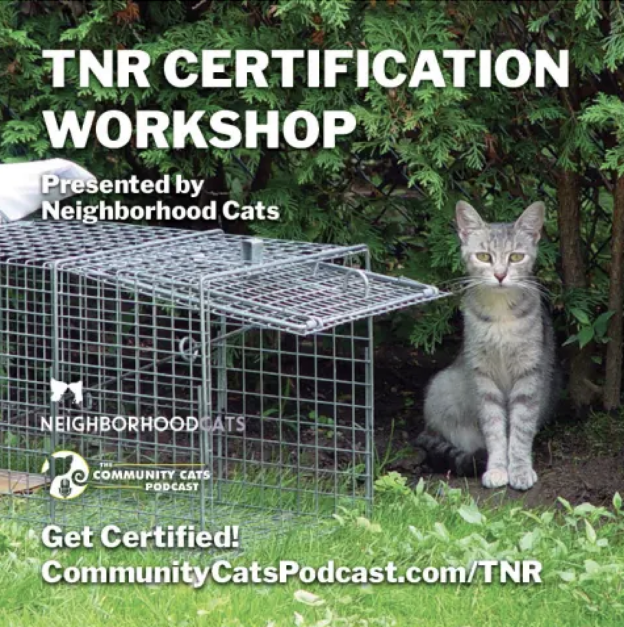
  • Online Event – 7/14/24 – Neighborhood Cats TNR Certification Workshop – Community Cats Podcast (small fee applies)

    Online Event – 7/14/24 – Neighborhood Cats TNR Certification Workshop – Community Cats Podcast (small fee applies)

    July 14, 2024 | 2:00-4:30PM EDT.

    REGISTRATION OPEN NOW
    Are you ready to be part of the solution for feral and stray cats in your neighborhood? Our expert instructors will teach you best practices for Trap-Neuter-Return (TNR) and colony management. Learn what TNR is and why it works. We’ll cover getting along with neighbors, preparations for trapping, trapping itself (including entire colonies at once), feeding, providing winter shelter, and more. Take advantage of the interactive format, extensive handouts, and video footage of actual projects. Attendees will receive a certificate of attendance and gain access to an ongoing Facebook group for networking with other TNR activists. Instructed by Susan Richmond, executive director, and Bryan Kortis, national programs director.

    Session duration is 2.5 hours, followed by an optional 15-minute Q&A session.

    This course/webinar/series/conference has been approved for Continuing Educational Units by the National Animal Care & Control Association (NACA). National certificate holders can submit for credit consistent with the NACA CEU policy located https://nacatraining.org/continuing-education-recertification/


    WEBSITE LINK:  https://www.communitycatspodcast.com/events/the-neighborhood-cats-tnr-certification-workshop-july-2024/

  • Webinar – 7/25/24 – Help for the Helpers: Recognizing and Addressing Stress Injury in Animal Control Officers – NACA/Justice Clearinghouse

    Webinar – 7/25/24 – Help for the Helpers: Recognizing and Addressing Stress Injury in Animal Control Officers – NACA/Justice Clearinghouse

    The past few years in animal welfare have been especially difficult, leaving many profoundly depleted. Given the challenges in our field, what can we do to care for ourselves, our peers, and our staff? This webinar will provide an introduction to common occupational stressors in animal protection services and evidence-based strategies to support well-being in complex stress, trauma-exposed work.

    Participants will learn terminology, symptoms, and risk factors related to empathic strain aka compassion fatigue, secondary traumatic stress, PTSD, burnout, and moral distress. The session will provide practical, effective strategies that can be implemented on and off the clock to reduce stress and distress, create healthier workplaces, and tap into career-sustaining compassion satisfaction.

    At the end of the session, participants will:

    • Identify key signs and symptoms that characterize stress injury in self and others
    • Understand five evidence-based elements shown to reduce the harmful impact of stress and adversity in ongoing stressful work
    • Implement simple strategies to support physical and mental recovery
    • Offer targeted support to peers and staff through more effective check-ins


    This webinar has been certified by the National Animal Care & Control Association and is approved for 1 Continuing Education Unit. Please refer to your NACA membership portal for current CEU submission process. Current NACA Members who attend the live presentation or watch the recording will be able to download a jointly issued attendance certificate that includes the National Animal Care & Control Association logo. Visit the NACA training page for a complete list of future trainings.


    This webinar has been pre-approved by the Maine Animal Welfare Program for 1 Continuing Education Unit in Core Area 4 (Officer Wellness & Mental Health) for the State of Maine’s ACO annual training. You can find more information about Certification, required annual training or submitting materials for credit at Maine’s Animal Control Officer Resource Page.


    About the Presenter:

    Jessica Dolce, MS CCFE, is a Certified Compassion Fatigue Educator, receiving her training from TEND Academy. She brings 20 years of experience working with and for companion animals to The Compassion in Balance® Program, her online education platform for animal shelters.

    She is an instructor with The Shelter Medicine Program at the University of Florida where she teaches wellbeing courses for veterinary students and animal welfare professionals. Jessica has worked with organizations such as the ASPCA, HSUS, The Animal Legal Defense Fund, The National Wildlife Rehabilitators Association, and Animals Asia.

    Jessica holds a Master of Science in Adult and Higher Education degree and is certified in Mental Health First Aid. She lives in Maine and can be found online at her website, jessicadolce.com.

    WEBSITE LINK:  https://www.justiceclearinghouse.com/webinar/help-for-the-helpers-recognizing-and-addressing-stress-injury-in-animal-control-officers/

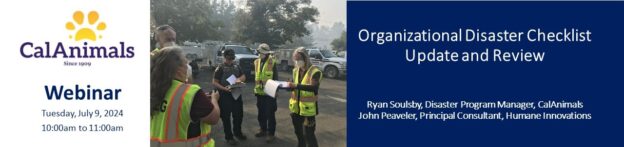
  • Webinar – 7/9/24 – Organizational Disaster Checklist Update and Review – CalAnimals

    Webinar – 7/9/24 – Organizational Disaster Checklist Update and Review – CalAnimals

    The CalAnimals Emergency Management Committee created a terrific resource called the Organizational Disaster Preparedness Checklist, sponsored by Hills. CalAnimals has added some useful sections and updated current information and links. Please join us as we take a refreshing look at the Checklist and drive into the updates. The Checklist is designed to help local animal welfare agencies by providing ideas for protocols, contracts, networking, and support during a disaster. Taught by CalAnimals Disaster Program Manager Ryan Soulsby and Principal Consultant John Peavler of Humane Innovations.

    If you missed the original webinar in 2021, here is the link: https://us02web.zoom.us/rec/share/FExuaOLi8-JLsi2dguxPAGfMvEk2S3PnZ5z4WKG4cs2lWgz7NJP4Tedz4pQqbqeQ.GQ1tMFbhjjawLD0p. This training will give a brief overview of the original Checklist, but primarily focus on the new sections and updates.

    WEBSITE LINK:  https://us02web.zoom.us/webinar/register/WN_Dwyl3aRtQsaT28qso7j4KA#/registration

  • Webinar – 6/27/24 –  Animal Disaster Response & Preparedness: An Overview – CalAnimals

    Webinar – 6/27/24 – Animal Disaster Response & Preparedness: An Overview – CalAnimals

    Disasters come in a variety of forms and can have wide-ranging implications for the communities we serve. Taught by CalAnimals Disaster Program Manager Ryan Soulsby and Principal Consultant John Peaveler of Humane Innovations, this course provides an overview of preparedness and response, including the unique challenges faced by Animal Care and Control Professionals.

    WEBSITE LINK:  https://us02web.zoom.us/webinar/register/WN_8hShtDlPS-WklTIf9EKPsw#/registration

  • Webinar – 8/13/24 and 8/14/24 –  Update on Antimicrobial Use and Stewardship Recommendations in Large and Companion Animals – CVMA (fee applies)

    Webinar – 8/13/24 and 8/14/24 – Update on Antimicrobial Use and Stewardship Recommendations in Large and Companion Animals – CVMA (fee applies)

    This online seminar will cover important updates on antimicrobial use in both large and companion animals, as well as recommendations for antimicrobial stewardship.

    Topics that will be discussed include:

    1. Why antimicrobial stewardship is crucial in veterinary medicine
    2. Updates on culture and sensitivity reporting
    3. Updates on stewardship practices and recommendations in large and small animals
    4. Applying the data to practical use in clinics

    This course satisfies the one hour of California CE requirement on the judicious use of medically important antimicrobial drugs.

    This course qualifies for 1.5 CEU.

    CVMA Online Seminars are convenient interactive presentations offering CEUs held in real-time. This learning platform allows you to participate from anywhere with internet access – from your practice, your home, or anywhere you have an internet connection. Attending is as easy as a few mouse clicks. You will only need internet access and either computer audio, a headset, or a telephone.

    This seminar is open to veterinarians, veterinary technicians, veterinary hospital staff, and veterinary students only.

    WEBSITE LINK:  https://cvma.net/continuing-education/upcoming-ce/cvma-online-seminar-antimicrobial-webinar-august/cvma-online-seminar-update-on-antimicrobial-use-and-stewardship-recommendations-in-large-and-companion-animals-august-13-amp-14-2024/

  • Online Event – 7/2/24 – All Call: Dr. Jyothi Robertson and Donell Randolph on Community Clinics – California for All Animals

    Online Event – 7/2/24 – All Call: Dr. Jyothi Robertson and Donell Randolph on Community Clinics – California for All Animals

    At the July 2 All Call, Dr. Jyothi Robertson (DVM, DABVP, Shelter Medicine) and Donell Randolph (Human Animal Support Services Coordinator) will present on Oakland Animal Services’ community clinics.

    The All Call is a twice-monthly, California community call for animal well-being professionals that occurs on the 1st and 3rd Tuesday. The one-hour call is a dedicated space to share and learn from each other. Popular topics include initiatives that create a more inclusive culture for both staff and community, programs that keep pets with their people, industry trends, research studies, as well as the hard stuff, like what’s not working or what is particularly difficult during times of scarcity. The call is a mix of presentations, storytelling, open discussion, and Q&A time.

    The All Call is hosted by California for All co-leaders Allison Cardona and Nadia Oseguera and is enriched by rotating facilitators. You only need to register one time. Calls are sometimes recorded; recap emails with supplemental resources are sent post-call.

    Register here: https://tinyurl.com/all-call