
Shelter Learniverse and Industry-Wide Calendar

Author: Elise Winn

  • New Adoption Counseling Course for Shelter Staff, Volunteers, and Fosters

    New Adoption Counseling Course for Shelter Staff, Volunteers, and Fosters

    There’s a new, free self-paced course available at Maddie’s® University, and it’s all about facilitating successful adoptions!

    This course provides guidance for navigating the entire adoption process, with an emphasis on adoption counseling. The course demonstrates the general adoption counseling process and then dives into adoption counseling for pets with behavior or medical conditions. Text content is supported by videos, infographics and exercises. All videos are shareable and all infographics are available for download so you can use them in training. 

    “This course goes deep on adoption counseling for cats and dogs and spans a number of interconnected topics,” co-author Rachel Jones shares. Topics include:

    • Customizing meet and greets for individual animals and their behaviors and medical needs.
    • Order of operations when receiving inquiries through different channels
    • Using approachable language when discussing different types of behaviors and medical needs.
    • Prioritizing counseling topics.
    • Important paperwork to consider.
    • Helping potential adopters determine whether a pet is a match themselves.
    • Setting adopters up for success in the home.
    • Fostering a welcoming environment.
    • Ways to simplify your own placement processes without sacrificing quality.
    • Minor marketing tips.
    • And more.

    The Adoption Counseling course is eligible for 2.0 hours of credit from the Association for Animal Welfare Advancement (AAWA) and the National Animal Care & Control Association (NACA).

  • Get More Animals Home with Back Where They Belong Summit Sessions and Resources, Now On-Demand

    Get More Animals Home with Back Where They Belong Summit Sessions and Resources, Now On-Demand

    Have you heard? By getting just 20% more stray dogs back home in our communities, we have the power to end unnecessary shelter euthanasia and find homes for every dog who needs one.

    Presenters from organizations across the country—municipal, non-profit, and national—came together in a mega event to share the best resources and most successful methods they’re using to reduce shelter crowding and get more dogs and cats back home. Now every short, solution-packed presentation and recommended resource is available on-demand at Maddie’s® University for free, #ThankstoMaddie!

    Pick the 25-minute sessions that speak to you. Whether you’re a field officer, frontline staff member, manager, or dedicated volunteer navigating tough decisions, topics like these will help you make a difference today:

    • The Crucial Role of Return to Home in Reducing Shelter Crowding and Euthanasia Today (Dr. Kate Hurley, UC Davis Koret Shelter Medicine Program)
    • Contracts, Jurisdictions, Fees and Local Ordinance Considerations to Promote Return to Home (Cole Wakefield, Good Shepherd Humane Society)
    • Empowering Dispatch With Training, Support and Resources for the Public (Michelle George, Companions and Animals for Reform and Equity—CARE)
    • Working With Finders to Help Get Animals Back Where They Belong (Mike Wheeler, Cabot Animal Support Services)
    • Getting Pets Home with Better Approaches to On-Pet IDs and ID/Microchip Tracing (Nina Stively, Loudoun County Animal Services)
    • Making It Easy for Owners to Find and Redeem Lost Pets: Tech Tips and Communication Strategies – Bobby Mann and Mia Navedo-Williams, Humane Rescue Alliance
    • Using Technology to Improve Your Lost and Found Systems (Elkie Wills, San Diego Humane Society)
    • And more!

    You’ll want to share these sessions with your team and stakeholders, including city leaders and decision-makers, to get everyone on board with programming that prioritizes getting dogs and cats back to the people and homes they know and love. Every single action we take together adds up. When it comes to making things better for shelter staff and animals, plus the people who are missing dogs and cats in the community, the impact is immeasurable.

  • Tackle Controlled Drug and Premises Permit Regulations Head-on to Deliver Better Care

    Tackle Controlled Drug and Premises Permit Regulations Head-on to Deliver Better Care

    Why this matters now

    Intakes are outpacing outcomes as communities and shelters are struggling to access veterinary care. A recent survey showed 66% of California shelters have no veterinarian on staff and 26% lack RVTs. Community members outside shelter walls face the same challenges to accessing care for pets, and the struggle is greater in underresourced areas and veterinary deserts where affordable care may be nearly impossible to come by.

    More than ever, it’s critical to make the most of the resources we do have, but first we have to understand the state and federal regulations that impact the care we can provide.

    What exactly does your shelter need to know about controlled drugs and premises permits? It’s all covered in a new on-demand webinar and short course from the Maddie’s® Million Pet Challenge Learniverse.

    Cut through the confusion and earn CE while you learn the essentials!

    In Decoding Compliance: What You Need to Know about Controlled Drugs and Premises Permits in Your Shelter, Bruce Wagman (Lead Counsel for SF SPCA’s Shelter Pals) and Cindi Delany (DVM and Director of Online Learning for Maddie’s® Million Pet Challenge) will guide you through each topic:

    • Understanding Legal Dynamics: Gain valuable access to the inner workings of the legal landscape governing medical and euthanasia services in shelters. Discover the transformative impact of understanding the agencies that impact the type and quality of care you provide.
    • Decoding Drug Enforcement Agency (DEA) & Veterinary Medical Board (VMB) Roles: Untangle regulations around controlled substances, enhance your understanding of premises permits, and gain insight into the role of premises permit holders, with a focus on compliance.
    • Strengthen Your Team: Gain insights into the diverse roles of licensed and unlicensed staff in delivering top-tier medical care within shelters. Equip your team with knowledge that will directly amplify care quality.
    • Facilitate Access to Medical Care in Shelters: Explore actionable solutions! Master the art of collaboration with regulatory agencies, opening pathways for advanced medical care for animals in your shelter and in your community.

    Discover where you can directly impact the standard of care animals receive in your shelter. Enroll today and get the resources you need to unlock crucial insights and feel empowered to address challenges and navigate the intricate landscape of drug and premises permit regulations. Join the ongoing discussion about this and other topics in the Shelter PALS Legal Series on Maddie’s® Pet Forum.

  • New Grant Could Help Your California Shelter Keep and Bring More Pets and People Together

    New Grant Could Help Your California Shelter Keep and Bring More Pets and People Together

    The latest California for All Animals grant cycle aims to power shelters’ efforts to remove barriers that separate people and pets and keep animals waiting for adoption. The More Pets and People Together Grant application period will be open to eligible organizations for 15 days beginning on Friday, September 15, 2023 at 7:00 a.m. PDT and ending on Friday, September 29, 2023 at 7:00 p.m.

    Who is eligible?

    Municipal animal shelters, private animal shelters with municipal contracts, and private shelters are eligible to respond to this RFP. A shelter is defined as a brick-and-mortar facility that houses animals on-site and is open to the public a minimum of fifteen hours per week. 

    Animal control agencies that provide field services and animal control functions are also eligible to apply, even if they do not perform sheltering services.

    If your organization does not meet these criteria, consider partnering with your local animal shelter or animal control agency.

    What might a proposal look like?

    The funding priority for this grant cycle is to enable animal shelters to take the necessary steps to dismantle barriers and create processes that can lead to the following measurable outcomes:

    • Preventing intake and keeping pets in their homes
    • Decreasing length of stay of animals in the shelter
    • Reducing euthanasia of healthy and treatable animals
    • Increasing live outcomes through foster, adoption and return to home/community

    Proposals could focus on removing barriers in adoptions, foster programming, Return to Home, and intake prevention services, though we also invite innovation outside these focus areas.

    For additional guidance, ideas and inspiration, download the From Barriers to Bridges Action Kit at the Cal for All website. You can also watch roundtable series recordings to hear your colleagues highlight their own collaborative approaches to removing barriers that come between people and pets and share creative solutions they’re implementing to ensure pets spend more nights at home, not in the shelter. 

    How do I apply?

    Visit California for All Animals for the full guidelines and simple grant application. If you have questions or need help, don’t hesitate to email us at grants@californiaforallanimals.com.

  • Expert Advice on Fighting Infectious Disease, Now On-Demand

    Expert Advice on Fighting Infectious Disease, Now On-Demand

    Any new treatments for resolving ringworm quicker?
    When should we vaccinate puppies and kittens?
    Do you have updates about the new monoclonal antibody treatment for parvo?

    These are just a few of the dozens of questions you asked Drs. Mehnaz (Chumkee) Aziz and Becky Stuntebeck during the webinar Curbing Disease As Intake Rises: Prevent Fight and Win Today. Now can find all the answers on-demand at Maddie’s® University!

    Curbing disease as intake rises - watch on-demand!

    Whether you’re providing daily care for animals or reviewing care and intake protocols, you’ll learn practical steps to relieve the strain on animals and team members. Get ready to UNLEARN unhelpful myths and walk away with tools and techniques that will lead to healthier animals, less stress for you, and make your job of serving the pets and people in your community easier.

    We’ve also posted new resources your teams can use to fight infectious disease, including

    • Infectious Disease Fast Facts posters to display in your shelter
    • Diagnostic testing guidance for outbreaks
    • A decision-making tree for dogs exposed to parvo
    • And more!

    Have a follow-up question about the content? Join the ongoing conversation at Maddie’s® Pet Forum. We welcome your webinar feedback via this short survey.

  • Join the California for All Animals Advisory Council

    Join the California for All Animals Advisory Council

    Calling all California strategic thinkers, status quo disruptors, and changemakers! Through July 14 the California for All Animals program is seeking qualified applicants for an advisory council. The council will assist, advise, and make recommendations on the strategic plan, grantmaking and implementation of the California for All Animals program. Members of the Advisory Council will provide input and feedback on the program implementation plans, grant guidelines and funding priorities for California for All Animals. Members will review grant application packages, provide input and vote on grant award decisions. 

    Could this be you? Yes! If you work or volunteer at a shelter or animal control agency, or if you work for a community-based organization or social services, or know someone who does, we are looking for you. Likewise, if you’re located in northern California, Imperial County, Riverside, the Central Valley or eastern California, please help spread the word. We are looking for broader representation in those communities.

    The challenges before the animal welfare field today are multifaceted and systemic. While we wholeheartedly acknowledge we have much to learn and unlearn, there’s one thing we know for sure: The way to a more humane-hearted California is more voices, more perspectives, more lived experiences, more diversity, more expertise, more cultural humility, more transparency and more seats at the table. 

    If you are ready to lend your perspective on California animals who are at risk, and if you want to be part of a community dedicated to keeping animals with the people who care for them, click below to learn about the California for Animals Advisory Council guidelines and compensation.

    Application window closes July 14th. Please reach out with any questions!

  • Celebrate ACO Appreciation Week with California for All Animals

    Celebrate ACO Appreciation Week with California for All Animals

    Field officers have to be adept at handling not only stressed animals but stressed people too. We appreciate their hard work and dedication every day, and we can’t say it enough. National Animal Control Officer Appreciation Week offers us a chance to pause and acknowledge the care and assistance they provide.

    This week at California for All Animals, we’re sharing the stories of just a few of the many amazing field officers working across the state. Join us in celebrating the ways they’re collaborating to build safer, healthier, more compassionate communities for animals and people, one conversation at a time.

    For officers like Christina Avila, working in animal welfare can be as challenging as it is rewarding. Nine years ago, Christina decided to step away, but after a year off, she was back, this time as a senior officer at City of Perris Animal Control, and everything changed. Or maybe it’s more accurate to say Christina changed everything. Find out how she went from total burnout to lighting a fire under her team to adopt a culture of support and create new opportunities for pets and people in her community.

    Visit the California for All Animals website to meet Christina Avila, and check back throughout the week for more ACO stories to come!

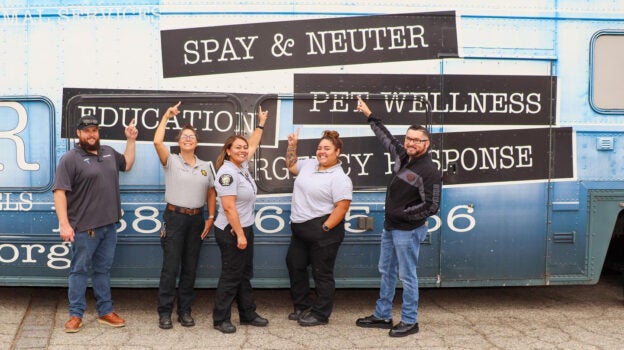
    Photo: Senior Animal Control Officer Christina Avila, center, celebrates a mobile spay/neuter community event with her team. Credit: City of Perris.

    Read Christina’s Story
  • Learn New Moves and Create the Change You Want With the Spring 2023 Shelter Summit and Fast Tracks

    Learn New Moves and Create the Change You Want With the Spring 2023 Shelter Summit and Fast Tracks

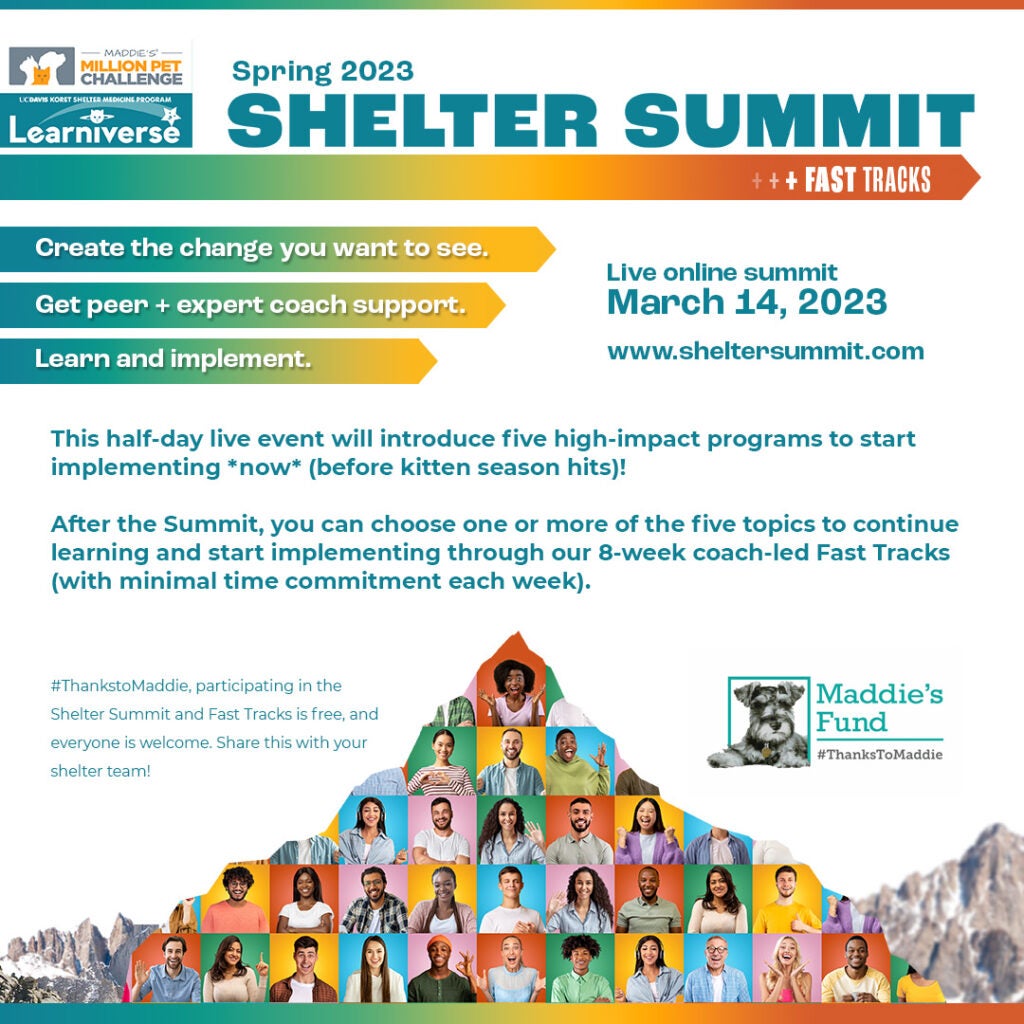
    Sometimes positive change happens in leaps, and sometimes it happens in strategic steps. The Maddie’s®️ Million Pet Challenge Learniverse Spring 2023 Shelter Summit and Fast Tracks will help shelter teams at all levels identify opportunities for both, no matter your shelter size or budget.

    On March 14, 2023 gather with expert coaches and peers in a half-day (9 AM – 12:30 PM Pacific), virtual Summit to explore 5 foundational topics that meet your most urgent challenges and get a bird’s-eye view of where your shelter could go next. Coaches will introduce 5 high-impact programs to start implementing now so you can maximize your resources and get set to thrive during kitten season and beyond:

    • Coordinated Care: The Secret Sauce to Ensuring Animals and People Get the Right Care in the Right Place
    • Are You Staying Within Your Capacity for Care? (You Might Be Surprised!)
    • Hidden Gems: How to Make Your Shelter Software Help You Work Smarter, Not Harder
    • Proven Barrier-Busting Strategies That Send Animals Home
    • Feeling Overwhelmed with Making Outcome Decisions? We Can Help!
    Social share image Spring 2023 Shelter Summit and Fast Tracks

    Fast-Track Change After the Summit

    Choose 1 or more of the 5 topics to continue learning and start implementing through 8-week coach-led Fast Tracks (with minimal time commitment each week). When you participate in a Fast Track, you’ll be able to sprint from idea to implementation and ongoing improvement by connecting with coaches and fellow participants in 4 live sessions alternating with 4 optional office hours.

    #ThanksToMaddie, joining a Fast Track is free and open to everyone, no application needed. Just pick your track or tracks and register to be able to join any or all of the Track’s meetings and office hours.

    Want even MORE information and coaching?
    Apply to run with an exclusive Track Pack for additional peer and coaching support

    You’ll move from Fast Track participant to pace-setter and gain even more momentum when you run with a Track Pack. Unlock dedicated coaching sessions and get the extra accountability, motivation, and inspiration you need to get the impact you want. Stay on track by advancing within a tight-knit group of shelters working side-by-side with your coaches to achieve your goals.

    As a Track Pack member, you could be spotlighted for other track participants to learn from your challenges and successes. You’ll cheer each other on, exchange experiences and ideas to turn setbacks into solutions, and measure progress together.

    Apply now; Track Pack spots are limited to ensure you get the dedicated coaching help you need! Applications will be reviewed on a rolling basis through March 31, 2023.

    This new, different, and better learning experience is designed with your feedback, your busy schedules, and your big goals in mind. Best of all, #ThanksToMaddie, participation in the Shelter Summit and Fast Tracks is absolutely free and everyone is welcome. Share this with your team!

    Learn More and Register
  • What Love Looks Like

    What Love Looks Like

    Twenty-two years ago this month, the UC Davis Koret Shelter Medicine Program was born, the first of its kind in the world, but luckily not the last.

    One year ago on Valentine’s Day, the KSMP came together with shelters, partner organizations, California changemakers and allies for people and pets to Share the Love and launch California for All Animals, the first state-funded program of its kind to unite and amplify the work of California animal shelters to achieve our shared goal of matching every animal in need with the right outcome through the right care, delivered in the right place and at the right time, and to help communities achieve the state’s policy goal that no adoptable or treatable dog or cat should be euthanized.

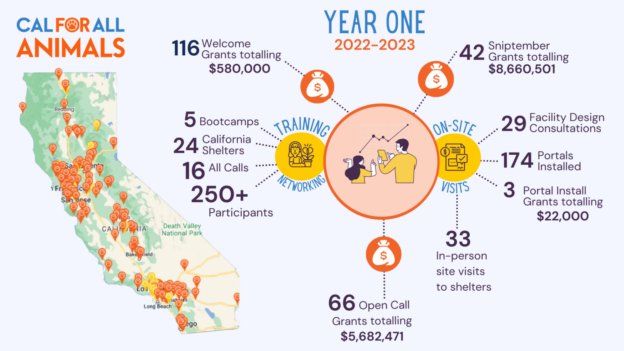
    We are thrilled to have awarded over $15 million in grant funding to shelters and animal control agencies in Cal for All Animals’ first year. This February 14, we’re reflecting on what love looks like through a new edition of the #allthenews newsletter:

    A lot has changed in the last two decades of shelter medicine. Our collective commitment to a humane-hearted California that builds well-being for animals and people, inside the shelter and out, has only gotten stronger. Here’s to all we can build together in the year ahead!

  • New ASV Guidelines Shape Path to Positive Well-being for Animals in Shelters

    New ASV Guidelines Shape Path to Positive Well-being for Animals in Shelters

    Just before the holidays, the Association of Shelter Veterinarians (ASV) shared big news and a big gift that we can turn to 2023 and beyond: the second edition of the Guidelines for Standards of Care in Animal Shelters is here!

    Three years in the making, the new edition incorporates updates based on the growing body of animal sheltering science and recommendations rooted in practical experience. Ultimately, the Guidelines seek to provide:

      • a set of common standards for the care and welfare of companion animals in shelters based on scientific evidence and expert consensus.
      • guidance that helps animal welfare organizations reduce overcrowding, stress, disease, and improve safety.
      • a tool for animal welfare organizations and communities to assess and improve their shelters.
      • references for creating regulations and statutes around sheltering, and benchmarks for organizational change.
      • guidance for animal housing in existing facilities and priorities for the design of new construction.
      • a living document that responds to developments in shelter medicine and animal care research and practice.

      While retaining the core goals of the Guidelines and emphasizing standards of care within shelter walls, the authorship task force also recognized the need to incorporate a broader, community-centered perspective.

      “We worked hard to consider implications on community well-being, other stakeholders and staff,” Chumkee Aziz, DVM, said. “Our hope is that the Guidelines provide shelters with updated standards in animal sheltering, while encouraging shelters to also focus on equitably supporting their community and keeping pets in homes.”

      From the Five Freedoms to the Five Domains

      ASV Guidelines Five Freedoms of Animal Welfare

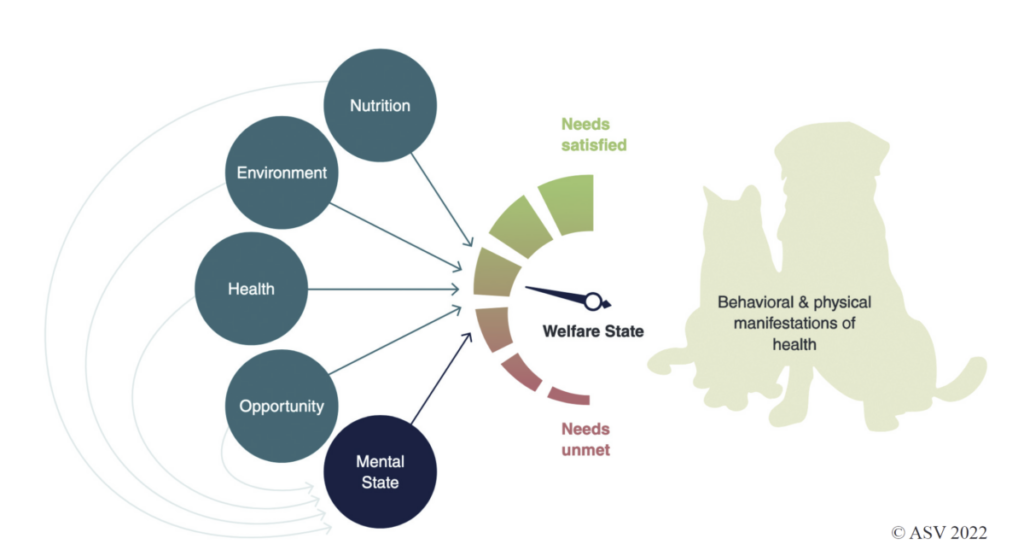
      Another major update reflects an evolution from the Five Freedoms of Animal Welfare to the Five Domains. 

      “The Five Domains embrace the Five Freedoms but go a step beyond,” Aziz said. “They emphasize that animals deserve every chance to maintain and experience positive mental states while in sheltering systems.”

      This edition also builds on the previous document with two new sections: additional references and expanded resources. View or download the Guidelines for Standards of Care in Animal Shelters and look for a checklist of key actionable statements coming soon.

      More Right Care Resources

      Ready to explore more resources focused on achieving positive welfare for animals in the community, inside and outside shelter walls, and get CE while you do it? Maddie’s® Million Pet Challenge Learniverse webinars and SPOT mods (self-paced online training modules) will guide you through the foundations of providing at-risk animals with the Right Care, in the Right Place and at the Right Time, to the Right Outcome, and they’re free to all, #ThankstoMaddie!