Shelter Learniverse and Industry-Wide Calendar

Blog

  • Online Event – 11/7/20 – Thinking Out of The Shelter: Taking Animal Care Into the Community – Ontario Shelter Medicine Association (fee may apply)

    Online Event – 11/7/20 – Thinking Out of The Shelter: Taking Animal Care Into the Community – Ontario Shelter Medicine Association (fee may apply)

    CPD/CE Day November 7, 2020
    Thinking Out of The Shelter: Taking Animal Care Into the Community

    MORNING: BIG PICTURE VIEW

    • Amanda Arrington – Pets for Life 
    • Alison Bressette – Aboriginal Community and Animal Advocacy Connection 
    • Dr. Ellen Jefferson – Human Animal Support Services 
    • Dr Michelle Lem – Community Veterinary Outreach 


    AFTERNOON   : LOCAL INITIATIVES IN CANADA

    • Phil Nichols RVT – Toronto Humane Society
    • Kristina Burns – Canadian Animal Assistance Team, Community Veterinary Outreach
    • Dr. Shane Bateman – University of Guelph
    • Dr. Esther Attard, Dr. Hanna Booth – Toronto Animal Services


    TALKS TO BE FOLLOWED BY A VIRTUAL HAPPY HOUR NETWORKING EVENT.

     For more details about the day, click HERE.

     Thank you to our generous sponsors!


    WEBSITE LINK:  https://www.ontariosheltermedicine.org/thinking-out-of-the-shelter-taking-animal-care-into-the-community/

  • Webinar – 11/3/20 – Revisiting Respondent Techniques – Change the Behavior by Changing the Emotions – PPG (fee applies)

    Webinar – 11/3/20 – Revisiting Respondent Techniques – Change the Behavior by Changing the Emotions – PPG (fee applies)

    CEUs: PPAB 1.5, CCPDT (pending), IAABC (pending), KPA (pending)

    When working towards solving behavior problems our focus tends to be on the behavior. This happens for a couple of reasons: firstly, behaviors are much more noticeable than the emotions that drive them; secondly, from the human perspective the behavior is the problem, not the emotion. From the dog’s perspective, however, the emotion is the problem, not the behavior!It is true that respondent conditioning and operant conditioning occur almost simultaneously, which results in an interplay between emotions and what the dog learns from punishers and reinforcers. Because of this interplay, we prioritize the “get the behavior” approach. But how much faster could a behavior problem be solved if we prioritized the “change the emotion” approach? Let’s remember that emotional states are antecedent stimuli, that motivation is an emotional process, and that emotional responses are more immediate than thought-out ones.This webinar will revisit respondent techniques such as classical extinction, systematic desensitization and counter-conditioning, as well as explain how to apply them effectively taking different variables into account.

    Learning Objectives

    • Understand the impact of emotions on behavior.
    • Become aware of emotional states as antecedent stimuli.
    • Learn how motivation contributes towards reinforced behaviors not being displayed and punished behaviors being displayed.
    • Learn why emotional responses are more immediate than though-out ones.
    • Understand classical extinction and how to apply it, reinstatement of an extinguished response, renewal and spontaneous recovery.
    • Learn the various types of counter conditioning and how to apply them effectively.
    • Develop skills to ensure a smooth desensitization process.
    • Avoid the pitfalls of flooding.

    About Your Presenter


    Alexandra Santos is a professional canine behavior consultant and trainer, with formal education through The Animal Care College in the U.K. where she graduated with honors for the Diploma of Advanced Canine Psychology, and through The Companion Animal Sciences Institute where she graduated with distinction for the Diploma of Advanced Dog Training.

    She is the author of the books “Puppy Problems”, “Puppy Training: How to house train your puppy effectively”, “How to leash train your dog and enjoy walking him”, “O meu cão e eu”, “Cão educado, dono feliz” (published in Portugal), and has also authored and co-authored several articles for the Journal of Applied Companion Animal Behavior and the International Institute for Applied Companion Animal Behavior.

    Alexandra lives and works in Lisbon, Portugal, as a guest professor at Universidade Lusófona de Humanidades e Tecnologias and provides individual coaching for dogs and their people. She has been a presenter at several seminars in Portugal and Brazil on positive reinforcement-based training and regularly presents webinars for the Pet Professional Guild.

    WEBSITE LINK:  https://petprofessionalguild.com/event-3909932

  • Webinar – 10/28/20 – Too Hot to Handle – Understanding and Working With the “Reactive” Dog – Dr. Christopher Pachel – Dog-iBox (fee applies)

    Webinar – 10/28/20 – Too Hot to Handle – Understanding and Working With the “Reactive” Dog – Dr. Christopher Pachel – Dog-iBox (fee applies)

    Arousal is necessary for normal day to day activity as well as for survival. We also know that arousal levels are supposed to change in response to environmental and social pressures, and that arousal can affect information processing and the modulation of fight/flight responses. Unfortunately, not all arousal regulation systems are created or developed equally! This presentation will focus on those dogs that are easily over-stimulated by sensory information, tend to over-react to their surroundings, and have a difficult time recovering or returning to a normal resting level of arousal. Information specific to the underlying neurological basis for this pattern, strategies for impacting the development of impulse control and arousal regulation throughout development, as well as behavior modification and medication intervention strategies will be addressed and discussed.


    WEBSITE LINK:  https://www.dog-ibox.com/market/catalog/live-webinars/live-webinars-english-c-34/too-hot-to-handle-understanding-and-working-with-the-reactive-dog.html

  • Town Hall – 10/29/20 – Cats outside, it’s going to be okay. – Best Friends

    Town Hall – 10/29/20 – Cats outside, it’s going to be okay. – Best Friends

    Why does our instinct tell us that a cat outside needs to be taken to a shelter? Once at the shelter, should cats be limited to indoor adoption outcomes? Are we really saving them?

    Join us for a holistic discussion around cats. Lead by Michelle Logan, director of national embed programming for Best Friends Animal Society, we will explore how as an industry we can best serve our community and its cats.

    Panelists:

    • Don Riser, animal services manager, Hesperia Animal Services
    • Osby Montes, senior animal control officer, Hesperia Animal Services
    • Audra Mullins, animal control officer, Santa Rosa County Animal Services
    • Leah Massey, community cat program manager, The Humane Society of Charlotte
    • Bennett Simonsen, community cat programs manager, Pima Animal Care Center

    Register here: https://bit.ly/37Aq532

    WEBSITE LINK:  https://network.bestfriends.org/tools-and-information/best-friends-town-halls


  • What?  KSMP is Hiring for One Special Role!

    What? KSMP is Hiring for One Special Role!

    Fellow animal welfare colleagues and large-scale change leaders, we are conducting a search for a Deputy Director of the Koret Shelter Medicine Program (KSMP), our small but mighty program dedicated to serving as change agents in our field. If you or someone you know is inspired by building and sharing the tools needed to implement humane, community-centered approaches to shelter management – click on the link below or email sheltermedicine@ucdavis.edu.

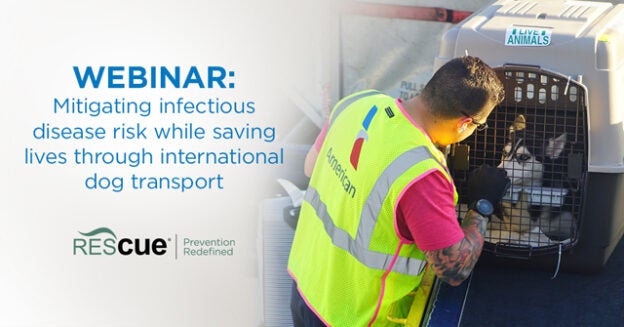
  • Webinar – 11/12/20 – Dogs on the Move​​​​​​ – Mitigating infectious disease risk while saving lives through international dog transport – Virox

    Webinar – 11/12/20 – Dogs on the Move​​​​​​ – Mitigating infectious disease risk while saving lives through international dog transport – Virox

    Dogs on the move – Mitigating infectious disease risk while saving lives through international dog transport

    During the last decade, increasing numbers of animal welfare organizations have begun working in poorly resourced areas around the globe in an effort to improve animal welfare. In areas with little capacity for local adoptions, sheltering organizations have started investigating whether international pet adoption might be a viable option to increase their live release rates. As a result, thousands of dogs and cats are being transported every year from places like Southeast Asia into adoptive homes in the US and Canada. This practice, while a life-saving mechanism for many animals, is not with inherent risks and controversy. The recent COVID pandemic has also heightened concerns regarding animal transport and disease importation. This presentation will discuss current trends in international companion animal transport, risks of importation to both animal welfare and public health, diseases of concern, and recommendations to mitigate the risk of unintentional infectious disease introduction and transmission.

    Katherine Polak, DVM, MPH, MS, DACVPM, DABVP (Shelter Medicine Practice)
    Head of Stray Animal Care – Southeast Asia, FOUR PAWS International
    https://www.katherinepolakdvm.work/
    ​​​​​​​
    Dr. Katherine Polak is a veterinarian dedicated to improving animal welfare in Southeast Asia, and in limited-resourced communities around the world. She currently serves as the Head of Stray Animal Care – Southeast Asia for FOUR PAWS International, a global animal welfare organization based in Vienna, Austria working to end the suffering of wild, stray, and farm animals.  Based out of Bangkok, Thailand, Dr. Polak currently manages a variety of companion animal programs in Thailand, Cambodia, Indonesia, and Vietnam, with a special focus on combating the cruel dog and cat meat trade in the region.  A boarded specialist in both Shelter Medicine and Veterinary Preventive Medicine, her focus is on veterinary training, high-quality, high-volume spay/neuter programs, and organizational capacity building.  She also serves as faculty at the University of Florida where she teaches in the online Maddie’s Shelter Medicine Program, sits on the WSAVA Animal Welfare Committee, and has also co-edited the textbook, ‘Field Manual for Small Animal Medicine’ with Wiley Publishing, a resource for veterinarians working in under-resourced communities.

  • Online Conference – 11/8/2020 – National Kitten Coalition Veterinary Conference 2020 – The National Kitten Coalition

    Online Conference – 11/8/2020 – National Kitten Coalition Veterinary Conference 2020 – The National Kitten Coalition

    The National Kitten Coalition invites veterinary professionals to attend our kitten-focused NKC Veterinary Conference!

    This Conference is made available to attendees for free thanks to our generous donors and sponsors. Join others -virtually- in learning information and approaches in caring for your youngest feline patients. Together we can increase the survival rates of kittens!

    This Conference program has been approved by the AAVSB for 4.5 hours of RACE® continuing education credit for veterinarians and credentialed veterinary technicians/nurses in jurisdictions that recognize RACE® approval. Recordings will be accessible for registrants after the Conference; however, CE Credit is only available for those attending the live session(s) on November 8th.

    Sessions include:

    “Kitten Development and Socialization” Leslie Sinn, DVM, DACVB

    “Best Practices for Best Outcomes in Kitten Spay/Neuter” Cynthia (Cindi) Delany, DVM, KPA-CPT

    “Kitten Health Scorer” Marthina (Marty) Greer, DVM, JD

    “Lessons Learned after 12 Years of Saving Bottle-Baby Kittens” Ellen Jefferson, DVM and Alexis Bardzinski, DVM

    “Helping Clients Help Kittens” Rosemarie Crawford, MA, BS, LVT

    We hope to ‘see’ you there!  For more information and to register visit https://kittencoalition.org/programs/national-kitten-coalition-veterinary-conference/.

    This Conference program has been approved by the AAVSB for 4.5 hours of RACE® continuing education credit for veterinarians and credentialed veterinary technicians/nurses in jurisdictions that recognize RACE® approval. Recordings will be accessible for registrants after the Conference; however, CE Credit is only available for those attending the live session(s) on November 8th.
    Thanks to our generous donors and supporters, registration is FREE!
    Click here for information about the conference sessions and speakers and click here to register.
    WEBSITE LINK: https://kittencoalition.org/event/national-kitten-coalition-veterinary-conference/
  • Cha Cha Cha Changes

    Cha Cha Cha Changes

    As the months move on and we settle into our new rhythm, some of our redesigned-by-Covid programs are starting to feel old hat now. While there is not a one-size-fits-all solution for every shelter, we know many of you have attempted to safeguard your shelter staff and community by reducing touch points. You moved to appointment-based services and extended your care options to include online/phone consultations, and you implemented curbside drop-off/pickup to manage contact and avoid crowded lobbies. You added parking spots with “text for service” messaging and moved your foster training online. Some of you launched home-to-home programs that bypass the shelter altogether, while others changed the direction of field officers’ vehicles by offering “foster delivery” services and suspending healthy “stray” (were they really lost?) cat pickup. 

    Despite most of these changes taking place rapidly under crisis conditions, we seem to be getting it right. The overwhelming response from shelter professionals has been clear: We’re not going back! 

    “Our animals are less stressed, dog bites are down, our staff loves the new appointment-based model…it started out scary, but it’s been great for our animals!”

    California Animal Shelter Covid Action Response member

    As a sheltering community, we’ve accepted chaos as inevitable. Stress and overwhelm are inherent; our cross to bear for doing this work. Covid brought business as usual to a grinding halt, a momentary pause that had the unintended but remarkable consequence of propelling the animal welfare industry forward a decade or more. 

    From where we stand (6 ft apart) today, we know overwhelm doesn’t have to be the norm. We know that our community will step up when we make room for them. We’ve seen the other side, a place where we operate within capacity and proactive policy making replaces reactive decision-making. We have felt the difference of a day that was predicted, scheduled, and managed versus another day that was survived. 

    Most importantly, we’ve been allowed space and time to give excellent service to both pets and their people and we’ve witnessed firsthand the difference time and attention makes to our outcomes.

    It’s no surprise the question on the proverbial streets has turned proactive, too: How do we institutionalize these changes before we slide back to the way it used to be?  Change experts would tell us the most critical step is to invite our stakeholders to hold the line with us by telling our story of transformation through transparent, value-first communication and asking them to be ambassadors of change. 

    Sounds easy enough, right? So why is there still a knot in our stomach. 

    Well, because this is animal welfare. A world in which people care an awful lot. Emotions and unchecked fears often bubble up and over, wreaking havoc on our best intentions. We all know a story of a shelter/rescue being dragged through the mud after instituting a new policy. Many of us have been a story. Despite our very best intentions, it’s not pretty when we lose control of the narrative. 

    So how do we get in front of it? How DO we tell our own story and drive positive change forward when emotions run high? The answer is by understanding the change process and what we should expect around every bend. Knowing what to expect allows us to be prepared to lead the positive messaging and not scrambling to react to mud being thrown our way. To stay ahead of the change (and its reputation), we have to know and address the concerns of our stakeholders. Unattended stakeholder fears are the enemy to progress!

    Last week we shared a link to a free resource, Change Management: The Role of Strategic Communication.  (Heads Up: You have to scroll down a list of free resources offered by Brighter Strategies to find the Strategic Communication workbook. You’ll need to enter your email to receive the downloadable workbook, but it’s worth it and they aren’t too spammy.) Take a moment to familiarize yourself with the Kubler-Ross curve and the stages of change. Ask yourself: 

    • Is the change we are experiencing proactive or reactive? 
    • What stage(s) of the Kubler-Ross curve are our staff, volunteers and/or board at? 
    • Based on our stage and the nature of our change (i.e. proactive or reactive), what are the emotions our stakeholders are likely experiencing? 
    To successfully move the change effort we want to see through our organization and our community, or to make a temporary change permanent, we have to complete the change cycle. Next week we are going to dive into what to do when a pandemic caused us to skip the first step of the change cycle and how we can go back to gather stakeholders left behind and move forward together. 

    Until then, have a peek at the Kurt Lewin Change model and take a moment to decide if you would classify your organization as being in the “unfreeze” stage, the “change” stage, or the “freeze” stage.  
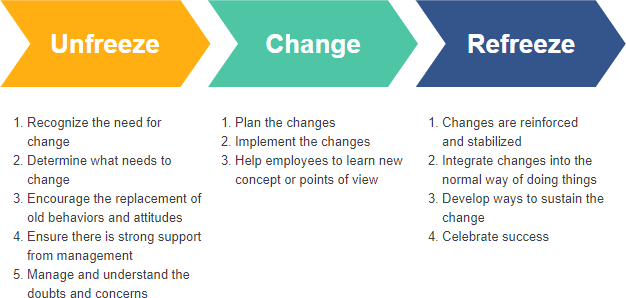


    +If you are feeling good: What makes you feel like you’ve moved on to stage two and are ready to do or are already doing the work associated with big change? Was there a moment you knew you had support and buy-in? 

    +If you are feeling unsure, fearful or uneasy: What makes you feel like you are stuck in stage one? Do you feel community pushback is keeping you from making progress? How is that pushback showing up?

    We’d love to hear from you! Please email us at sheltermedicine@ucdavis.edu and share what it’s like to be experiencing BIG change at your shelter right now. We want to hear the good, the bad, and the ugly. 
     

  • Webinar – 11/14/20 – Return to Field: What Is It, Why Do It, and How? – The Community Cats Podcast

    Webinar – 11/14/20 – Return to Field: What Is It, Why Do It, and How? – The Community Cats Podcast

    Return-to-field is an increasingly popular program for saving the lives of community cats. What is it exactly and why are shelters around the country embracing it? Neighborhood Cats, an active participant in two RTF programs and co-author of the new Return-to-field handbook published by HSUS, will take a deep dive into the policies and issues surrounding this still controversial approach. We’ll also look at how to run an RTF program, including ways that local groups and volunteers can contribute. Plus how to integrate RTF with TNR to achieve the biggest possible impact.
  • Online Course – 11/7/20 – Neighborhood Cats TNR Certification Workshop – The Community Cats Podcast (fee applies)

    Online Course – 11/7/20 – Neighborhood Cats TNR Certification Workshop – The Community Cats Podcast (fee applies)

    Join Neighborhood Cats and The Community Cats Podcast on November 7, 2020, from 2:00–4:30 p.m.** EDT to find out everything you need to know to become part of the solution for feral and stray cats in your neighborhood. Expert instructors will teach you the best practices for Trap-Neuter-Return (TNR) and colony management. Learn what TNR is and why it works.

    We’ll cover getting along with neighbors, preparations for trapping, trapping itself (including entire colonies at once), feeding, providing winter shelter, and more. Take advantage of the interactive format, extensive handouts, and video footage of actual projects.

    Attendees will receive a certificate of completion** and gain access to an ongoing Facebook group for networking with other TNR activists. Instructed by Susan Richmond, executive director, and Bryan Kortis, national programs director.

    **New York City-area attendees who earn their certificate will also qualify for free local TNR services, including spay/neuter, trap rentals, and expert hands-on assistance. If you are an NYC-area resident, please stay tuned after the class for an optional 30-minute session on how to access these NYC resources.

    PLEASE NOTE – Webinar registration links will appear on the page you will be sent to after completing your purchase and on your receipt. You must complete this step in order to participate in the event. If you do not receive a receipt, please email support@communitycatspodcast.com before November 6, 2020 for assistance. 

    WEBSITE LINK:  https://www.communitycatspodcast.com/product/neighborhood-cats-tnr-certification-workshop-nov-7/