We know shelters can be a stressful place for animals. And, even the best non-shelter veterinary clinic causes most happily owned pets fear, anxiety and stress. When you combine the two – a veterinary clinic setting in a shelter – the chance animals receiving needed medical care will be under significant stress skyrockets.
Being able to identify signs of fear, anxiety and stress in the animals in our care and do everything we can to decrease the negative impact of these emotions on the animals will keep them healthier and happier while they are with us. It will also help them find their forever homes sooner.
Employing Fear Free techniques will also keep the animals and our staff safer, make our own jobs easier and less stressful and enable us to provide better care.
In this session we’ll discuss how to recognize concerns in animals and give you strategies, techniques and tools to improve the emotional well-being of animals in shelters and particularly in the shelter clinic. We’ll discuss basic care, medical restraint and handling and adjunctive tools and therapies to consider following the Fear Free model.
We’ll also give you a preview of the free on-line certificate program – The Fear Free Shelter Program – that you and other shelter staff members can take now to learn more about this topic.
Learn how to leverage available data and free resources from Shelter Animals Count to empower all aspects of your organization. Learn from Shelter Animals Count – an independent, collaborative, first-of-its-kind organization gathering standardized data at local, state and national levels on animal intakes and outcomes in animal shelters – how to amplify grant requests through comparative local and national data and how to measure programming success. Even the most basic data collection is valuable in making decisions, steering operations, raising funds and more. Your shelter’s data becomes even more powerful when it is part of The National Database. Review sample use cases that give both basic and more complex actionable ways to apply data insights using free tools and resources. Access the Shelter Animals Count website on their devices. The National Database has data from 2011 – 2019 self-reported by thousands of organizations. Shelter Animals Count provides helpful tools for collecting and viewing data, all free for shelters and rescues to use!
Let’s talk TELEMEDICINE! Boehringer Ingelheim has a cool web-based portal/app that gives clients access to their pet’s key medical and vaccination history, supports telemedicine, and integrates seamlessly with most veterinary practice management platforms. This is a great platform to stay in touch with your foster community and new adopters with live video consultations.
Don’t Just Survive, But Thrive! Practice Management Tips During COVID-19 & Beyond
Practice consultant Louise Dunn will be sharing insights and advice on how veterinary practices can best manage their business through these unprecedented times.
As the owner of Snowgoose Veterinary Management Consulting, Louise will share stories from practices that have successfully navigated this environment and provide management tips for the next phase: recovery and getting back to a new normal.
Amidst a still-unfolding public health and economic crisis, leaders of nonprofit organizations are profoundly challenged to sustain the support of their donors, members, volunteers, and other stakeholders.
This is a 24 minute presentation followed by an extended Q&A period.
Matt offers an espresso shot of substantive & actionable recommendations designed to help you protect the relationships upon which your organization depends.
Topics include:
• Taking care of yourself & your team
• Safeguard your donor management system
• 3 relevant questions to ask your largest donors
• 4 meaningful ways to connect with small donors
• Now what? What needs to change/what must stay the same?
• How to unleash the immense power of your volunteers
• Why your Vision Statement is suddenly more valuable than your Mission Statement
It can be hard to offer adopters, fosters, and pet owners support when you can’t meet them face to face. Learn how you can establish a free Behavior Helpline that allows you to help your community remotely. This webinar will show you how a Behavior Helpline can benefit your shelter, and how you can use the knowledge your shelter already possesses to run this program and assist pet owners in need.
Takeaways
How a Behavior Helpline can help your shelter and community
Logistics of setting up a Helpline
Identify the behavior needs of your community so you can pool your resources efficiently
Free webinar on telemedicine in the veterinary field. Learn how virtual care can improve practice efficiency, mitigate the effects of the pandemic on your practice, and enable you to expand care to underserved populations.
Kittens and Kitten Season bring special challenges this year.
Learn about some options and resources for how your facility should deal with these challenges and then transition to a “new normal” once we are through this crisis.
People are worried. Looking at the data collected from over a thousand PetPoint shelters throughout the USA for the week of March 28-April 3, revealed remarkable drops in both intake and outcomes. In general, that made sense. In order to slow the spread of COVID-19, many shelters were open to the public for emergencies only, and communities had really stepped up to foster, opening space in the shelters in preparation for a possible onslaught of intakes when the pandemic peaks. But why was there a 47% drop in stray intakes since the start of the pandemic? Were thousands of stray dogs and cats suddenly roaming the streets, injured, hungry, scared, and desperately in need of shelter?
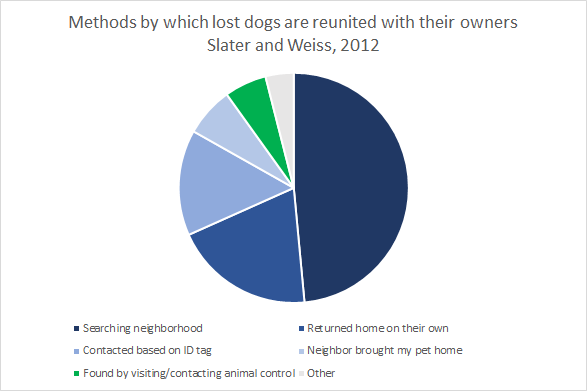
Shelter staff know the answer to that last question is “No.” The animals are getting home without actually needing to enter the shelter at all. Thanks to social media like facebook and Nextdoor, community members are able to reunite wandering pets with their owners directly, and owners can find their lost pets quickly. A quick look at my neighborhood Nextdoor yielded three lost-and-found mini-dramas in just the last few days. One owner found her dog by driving around the neighborhood right after she posted that he’d escaped her backyard through a hole in the fence. That’s not unusual. A 2012 study by Slater and Weiss found that almost half of owners trying to find lost dogs succeeded simply by searching their neighborhood.
One finder who posted on Nextdoor brought a friendly dog inside, took some photos, and posted them. Soon after, the relieved owner wrote, “Omg he’s mine!!…You’re an amazing soul!” Our local animal control is still taking in non-emergency cases. The finder took the dog to animal control, so the owner had to go to the shelter to pick up their pet. If the shelter had suggested the finder deal with the owner directly, that would have eliminated one touch point in the transaction.
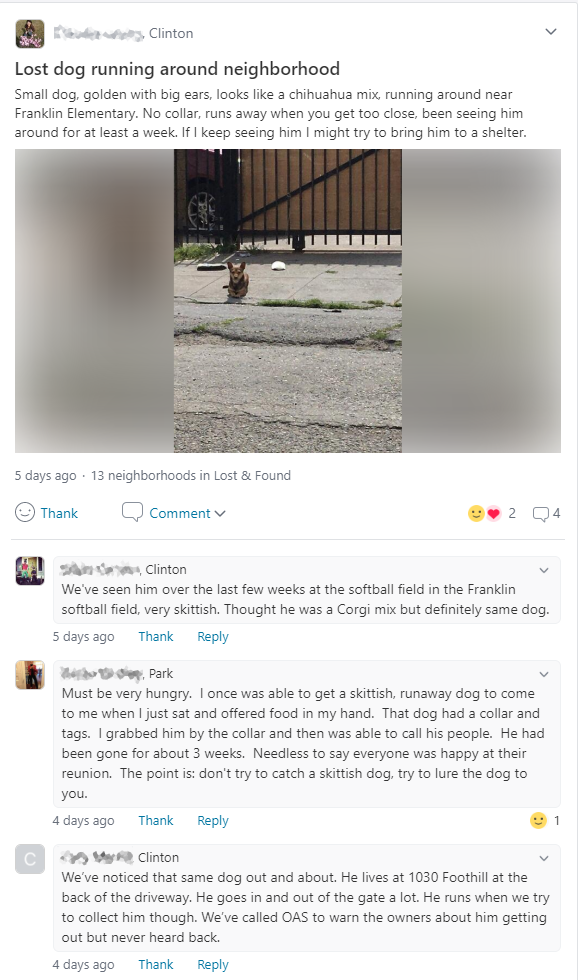
This third Nextdoor post is a great example of how a community comes together to solve the mystery of a “stray” dog:
Note a small detail in that last comment: “He goes in and out of the gate a lot.” While we might want to take this little dog’s owners aside and tell them to put a collar and tags on him, and perhaps fortify their gate with some chicken wire along the bottom, what’s worth noting is that the dog is not stray or lost; he’s just taking a solo walk around his neighborhood. In fact, “Returned on their own” makes up 20% of the “Methods by which lost dogs are reunited with their owners” pie in that Slater and Weiss study. Another 15% represents dogs who were returned by finders calling the phone number on the dog’s tags.
We’re all familiar with the statistic that cats are at least ten times more likely to get back home when they bypass the shelter entirely. From Slater and Weiss, we can infer that we never even hear about or come across most lost dogs. The truth is most companion animals never interact with a shelter, and isn’t that really what we want? We are one (vital) part of a community safety net for pets and pet owners. We always need to be able to provide a safe, healthy environment for animals in the shelter, and to protect animals and the public outside the shelter walls.
When a pandemic sharpens our focus and narrows our priorities, it can be hard to let go of the things we have been doing for years to help animals and keep our communities safe. When weighing an activity against the potential for spreading the virus that causes COVID-19, we have to ask, “Is this truly an emergency?”
Is the dog in poor body condition? Is the dog in danger? Is the dog a danger to others? If the answer to all of these questions is “No,” we can empower community members to find a solution that doesn’t include a trip to the shelter. While we don’t have any numbers around this yet, it’s worth saying that as the sheltering world has come together to share notes and compare strategies, we haven’t heard of an increase in dead animal pickups; if anything, anecdotal evidence suggests that dead animal pickups are down.
It probably helps that with their owners home, dogs have less reason to break out of their yards, and that staff now have time to triage and help pets stay in homes.
People have gotten the message that shelters have had to suspend business as usual. Communities have really stepped up to help animals in response to this pandemic: fostering rose by nearly 800% in the third week after the federal declaration, compared to the same time last year. People in front of their computers all day are using social media to stay in contact with friends…and also to return roaming pets to their owners. That frees us up to concentrate our efforts where they’re needed most.
Are your skills a little rusty? Or maybe you missed a few things during initial training? Our next webinar is on Chameleon basics. We are going to do a basic new user overview, talking about field types and how they are used, navigating the software, settings and basic customizability. Beginners welcome! This will be a 90-minute webinar to make sure we have enough time.