
Shelter Learniverse and Industry-Wide Calendar

Blog

  • Webinar – 2/8/24 – Maddie’s Insights: The Influence of Field Trip and Sleepover Programs on Shelter Dog Welfare – Maddie’s Fund

    Webinar – 2/8/24 – Maddie’s Insights: The Influence of Field Trip and Sleepover Programs on Shelter Dog Welfare – Maddie’s Fund

    Animal shelters can be stressful for dogs, but human interaction, such as foster caregiving, can improve their experience. In this webcast, Dr. Gunter will discuss multiple studies she and her team have carried out as part of the Arizona State University/Virginia Tech Maddie’s Nationwide Fostering Study in which we studied the effects of field trip and sleepover programs on the welfare of dogs living in shelters. Their initial studies investigated the physiological impacts of these programs, and their published study examined how field trips and sleepovers influenced dogs’ likelihood of adoption and length of stay. They also explored factors related to the performance of these programs. Overall, their findings support the implementation of these programs. Learn how you can use short-term fostering programs to improve the welfare of dogs in your shelter as they await adoption.

    Learning Objectives:

    • Describe potential stressors that make shelters stressful for dogs
    • Relate how human social interaction can improve the welfare of dogs in the shelter
    • Extrapolate the different activities dogs likely engage in during field trips and sleepovers
    • Discuss the research findings about field trips and sleepovers
    • Differentiate how field trips and sleepovers impact dogs’ proximate and distal welfare

    This webinar has been pre-approved for 1.0 Certified Animal Welfare Administrator continuing education credits by The Association for Animal Welfare Advancement and by the National Animal Care & Control Association. It has also been submitted for approval for 1 hour of continuing education credit in jurisdictions which recognize the Registry of Approved Continuing Education (RACE) approval.

    Register once for all Maddie’s Insights webcasts here: https://maddies.fund/MIwebcasts

    After the webcast, continue the conversation on this thread in Maddie’s Pet Forum: https://maddies.fund/MIwebcastsFosterCareImpact

    About the presenter:
    Dr. Lisa Gunter, Assistant Professor of Animal Behavior and Welfare at Virginia Tech

    Before beginning her graduate studies, Dr. Lisa Gunter worked for nearly a decade with dogs in animal shelters and with pet dogs and their owners. The goal of Lisa’s research is to better the lives of companion animals and their owners. To this aim, she has investigated the breed labeling of shelter dogs, their breed heritage, shelter housing and social interactions, temporary and long-term fostering, short-term outings, behavioral indicators of welfare, post adoption interventions focused on owner retention – and more recently, fostering during the pandemic and safety net programs to help keep people and their pets together. Under the mentorship of Clive Wynne, Lisa earned her Master’s in 2015, and her PhD in 2018 as a graduate student in the behavioral neuroscience and comparative psychology program at Arizona State University.
    WEBSITE LINK:  https://maddies.fund/MIwebcasts

  • Online Event – 2/27/24 – The Roundtable: HR with an Eye on DEI -The AAWA

    Online Event – 2/27/24 – The Roundtable: HR with an Eye on DEI -The AAWA

    Join us for a discussion with industry leaders about building a fair and just workforce. Learn how they’re recruiting and onboarding talent through a lens of diversity, equity, and inclusion. Panelists will share highlights and challenges they experienced along the way, while attendees will walk away with next steps for updating their recruitment and onboarding initiatives. This session will benefit hiring teams and hiring managers who are preparing to recruit new talent at their shelters and organizations.

    The Roundtable Panel:

    • Meshia Burrell, Vice President of People and Culture, The Anti-Cruelty Society
    • Aubrey Daniels, HR Manager, Pasado’s Safe Haven
    • Mark Neff, Executive Director, Forsyth Humane Society

    Moderated by Jasmin Robinson, Director of DEI Initiatives, The Association for Animal Welfare Advancement

    This roundtable has been approved for 1 Certified Animal Welfare Administrator continuing education credit.

    WEBSITE LINK:  https://learning.theaawa.org/p/RT-2-27-24

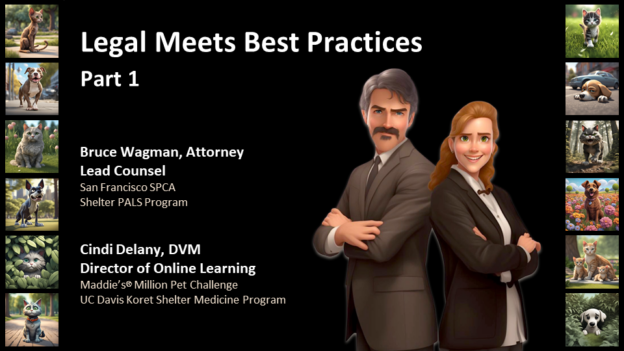
  • Legal Meets Best Practices – California Focus

    Legal Meets Best Practices – California Focus


    Watch Recorded Webinars

    The webinars you’ve been asking for!

    Legal Meets Best Practices: Translating California regulations into best practices that benefit you, your shelter, and the people and animals in your community.

    Join us in this two-part series as we embark on a fun, interactive journey to demystify California’s legal landscape and discover how California laws and regulations can work in harmony with shelter policy to reduce unnecessary intakes and shorten shelter stays.   Webinar recordings are available on-demand at Maddie’s&reg University.

    In this series, we will cut through the legalese, distill key takeaways, and provide you with practical, “what does this mean for me and my work?” guidance. If your shelter squad only ever attends one webinar series about how legal guidelines can be used to your advantage let this be the one!

    At the end of this series, you’ll understand how California laws and regulations should impact and inform best practices in how your shelter approaches critical areas including: 

    • Improving Community Cat Programs
    • Getting lost animals home fast
    • Focusing intake on the neediest animals
    • Knowing intake & holding period requirements
    • Knowing who can do what in the shelter

    Powered by partnership.

    This webinar is brought to you by the Maddie’s Million Pet Challenge Learniverse at the UC Davis Koret Shelter Medicine Program, San Francisco SPCA’s Shelter PALS program, and CalAnimals.

    By sharing our diverse expertise and working together to find the intersections where California law impacts animal shelters, we’ve formulated holistic shelter practices that allow you to better leverage the law.


    Watch On Demand at Maddie’s University

    Both webinars will be recorded and available on-demand after the live events.


    Watch Recordings

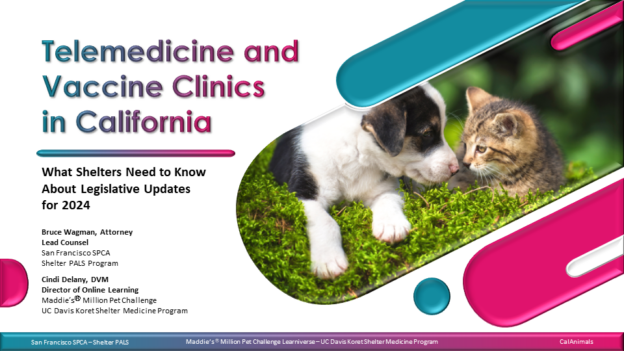
  • Telemedicine and Vaccine Clinics in California 2024

    Telemedicine and Vaccine Clinics in California 2024

    Telemedicine and Vaccine Clinics in California


    What Shelters Need to Know About Legislative Updates for 2024


    Watch the Recording and Download the Resources

    The webinar you need, right when you need it!

    Telemedicine and Vaccine Clinics in California


    What Shelters Need to Know About Legislative Updates for 2024

    We’ve got amazing news about access to care in animal shelters for 2024. Thanks to groundbreaking veterinary telemedicine and vaccine clinic legislation, your California shelter can ring in the new year with fewer restrictions around who can provide essential care and how, freeing up your team to more easily meet medical needs in the shelter or community.

    Discover how your shelter can:

    • Empower RVTs to take charge of vaccine clinics (even if your vet is elsewhere)
    • Provide increased access to wellness care for pets in your community 
    • Use telemedicine to expand the veterinary care your shelter can provide, whether an animal is in foster or in the field, working with staff or contract veterinarians
    • Increase access to care for underserved pets and their people and decrease unnecessary intake
    • Use telemedicine to increase veterinary care for animals in the shelter 

    Join our experts:

    This must-see webinar will set the stage for everything you do this year.

    Bruce Wagman, Attorney


    Lead Counsel


    San Francisco SPCA


    Shelter PALS Program
    Cindi Delany, DVM


    Director of Online Learning


    Maddie’s® Million Pet Challenge


    UC Davis Koret Shelter Medicine Program

    Powered by partnership.

    This webinar is brought to you by the Maddie’s Million Pet Challenge Learniverse at the UC Davis Koret Shelter Medicine Program, San Francisco SPCA’s Shelter PALS program, and CalAnimals.

    By sharing our diverse expertise and working together to find the intersections where California law impacts animal shelters, we’ve formulated holistic shelter practices that allow you to better leverage the law.

    Maddie's Million Pet Challenge and UC Davis Koret Shelter Medicine Program combined logo


    Watch On Demand at Maddie’s University

    Watch the webinar and download a treasure trove of associated resources, all free #ThanksToMaddie!


    Watch Now!

  • Webinar – 1/25/24 – In Whose Best Interest? with Karen Deeds – FDSA (fee applies)

    Webinar – 1/25/24 – In Whose Best Interest? with Karen Deeds – FDSA (fee applies)

    This webinar will not outline any training or behavior modification. What it will do is present your options for dogs with serious behavior problems and give you a framework about how to make an educated decision regarding those options. Is management alone an appropriate option? Or is your problem too severe to chance management failure? Is the problem one that can be responsibly transferred to another owner and/or another environment successfully? The same variables to help determine what option is best for you, will also be critical in determining if training and behavior modification are a viable option as well as how successful that option may be. The agonizing decision to discuss behavioral euthanasia with your veterinarian can also be analyzed logically by using these same variables. This can be a difficult topic. But it is important to keep in mind, in whose best interest we decide.

    Whether you are part of a rescue group, shelter staff, or volunteer, dedicated dog owner, professional trainer or behavior consultant, or a veterinarian working with a client, this webinar will help to make an appropriate decision regarding a dog in your care.

    Join Karen Deeds as she takes you through over 20 variables about the dog, the environment, and the people involved to help you determine what option is best for a dog with serious behavior issues.

    WEBSITE LINK:  https://www.fenzidogsportsacademy.com/index.php/self-study/webinars

  • Online Course – Starts 2/21/24 – Lifesaving by the Numbers: Effective Population Management in Animal Shelters – VIN (fee applies)

    Online Course – Starts 2/21/24 – Lifesaving by the Numbers: Effective Population Management in Animal Shelters – VIN (fee applies)

    Course Information:
    Proactive population management is a cornerstone of health and welfare for shelter populations. Reducing length of stay in animal shelters reduces the risk of infectious disease, as time in the shelter is the top risk factor. Behavioral welfare is improved when animals spend less time in the shelter.

    Strategies to reduce length of stay include daily population rounds, tracking animal flow through the shelter and removing bottlenecks, pathway planning, open selection, managed admissions, and fast-tracking of highly adoptable pets. The course will also cover practical strategies to build efficiency in medical programs, as many of the common bottlenecks are related to the provision of veterinary care. Additionally, while daily population rounds are crucial for collaboration across shelter teams and are key to ensuring animals keep moving on their shelter pathway, they can be challenging to implement, particularly in large shelters.

    Presenter: Erin Katribe, DVM, DABVP (Shelter Medicine Practice)
    Course Open: February 21-March 9, 2024
    Real Time Sessions (RTS): Wednesday, February 28, 2024; 8:00-10:00 pm ET (USA) World Clock Converter
    Total CE Credit: 2
    RACE Category: 2 hours Medical

    Learning Objectives: Upon completion of the course, the participant should be able to

    • discuss the benefits of reducing length of stay on individual animal health, lifesaving capacity of the shelter, and individual animal behavioral welfare.
    • define capacity for care in a shelter.
    • discuss how to determine average or median length of stay.
    • define pathway planning.
    • dDiscuss the following strategies for reducing length of stay:
      • Pathway planning
      • Fast-tracking
      • Open selection
      • Managed intake/admissions and intake diversion
    • discuss the goals and practical implementation of daily population rounds.
    • discuss the importance of tracking key metrics in shelter populations, including length of stay, intake and outcome metrics, and disease incidence metrics.

    Level and Prerequisites: This basic VIN CE course is open for enrollment to veterinarians and veterinary technicians/technologists interested in strategies to reduce length of stay while also reducing infectious disease spread in the shelter setting.

    WEBSITE LINK:  https://www.vin.com/ce/SHEL102-0224.htm

  • Online Course – Starts 2/6/24 – Medical Aspects of Community Cat and Trap-Neuter-Vaccinate-Release Programs – VIN (fee applies)

    Online Course – Starts 2/6/24 – Medical Aspects of Community Cat and Trap-Neuter-Vaccinate-Release Programs – VIN (fee applies)

    Course Information:
    In shelters across the country, dramatic increases in feline lifesaving have been accomplished through the implementation of community cat programs. Community cat programming consists of a combination of proactive, targeted trap-neuter-vaccinate-release (TNVR) and shelter-neuter-return (SNR) programming as a live outcome pathway for cats that enter the shelter system.

    In this course, learn techniques to safely handle community cats in the high-quality, high-volume, spay/neuter clinic or private practice setting, preventive care protocols for TNVR/SNR cats, how to design a multi-modal anesthetic protocol appropriate for TNVR/SNR cats, surgical techniques for efficient sterilization, techniques for prevention and management of surgical complications, and management of common conditions found in free-roaming cats that enter the shelter or present for sterilization surgery (ectoparasites, traumatic injuries, upper respiratory tract disease).

    Presenter: Erin Katribe, DVM, MS, ABVP (Shelter Medicine)
    Course Open: February 6-23,2024
    Real Time Sessions (RTS): Tuesday, February 13, 2024; 8:00-9:30 pm ET (USA) World Clock Converter
    Total CE Credit: 1.5
    RACE Category: 1.5 hours Medical

    Learning Objectives:
    Upon completion of the course, the participant should be able to

    • describe programs that shelters may implement to increase live outcomes for cats.
    • describe the components of a comprehensive community cat program.
    • discuss the impact of targeted TNR programming on feline populations.
    • describe preventive care protocols for community cats.
    • describe principles of managing feral/unsocialized cats in an HQHVSN setting.
    • discuss options for anesthetic protocols in TNR/SNR cats for sterilization.
    • discuss techniques for efficient sterilization surgery.
    • discuss techniques for prevention of surgical complications in high-risk cases and management of these complications when they occur.
    • describe techniques to safely handle unsocialized cats in the HQHVSN setting.
    • discuss strategies to prevent transmission of infectious disease in the HQHVSN setting.
    • describe options for treatment/management of these infectious diseases in TNR/SNR cats and compare/contrast with management of privately-owned pet cats:
      • Feline upper respiratory tract disease
      • Notoedres cati
      • Otodectes
      • Injuries associated with trauma (fractures, wounds, spinal trauma)

    Level and Prerequisites: This basic VIN CE course is open for enrollment to veterinarians, and veterinary technicians/technologists actively interested in Community Cat and Trap-Nueter-Vaccinate-Release programs.

    WEBSITE LINK:  https://www.vin.com/ce/MULT315-0224.htm

  • Webinar – 3/14/24 – Surviving a High Profile Case: Living under Scrutiny and Not Jeopardizing the Case – NACA/Justice Clearinghouse

    Webinar – 3/14/24 – Surviving a High Profile Case: Living under Scrutiny and Not Jeopardizing the Case – NACA/Justice Clearinghouse

    This webinar will cover how to effectively do an animal case with public scrutiny and press interest.  Animal cases garner a lot of press and sometimes the press coverage has implications for your case.

    This webinar will offer tips on how to handle living under scrutiny and making sure your case is not jeopardized by it.  We will discuss jury voir dire, opening and closing statements, and witness preparation with these considerations in mind.

    This webinar has been certified by the National Animal Care & Control Association and is approved for 1 Continuing Education Unit. Please refer to your NACA membership portal for current CEU submission process. Current NACA Members who attend the live presentation or watch the recording will be able to download a jointly issued attendance certificate that includes the National Animal Care & Control Association logo. Visit the NACA training page for a complete list of future trainings.

    Presenter:

    Michelle Welch is a Senior Assistant Attorney General in the Virginia Attorney General’s Office and the Director of the Animal Law Unit at the Attorney General’s Office.  She is charged with taking all animal law questions in Virginia.  She is called on by agencies all over the Commonwealth to act as a special prosecutor in animal cruelty and animal fighting cases.  She frequently gives advice to local law enforcement authorities and prosecutors all over Virginia, across the nation, and internationally.  She also trains prosecutors, animal control, and law enforcement officers on the state of Virginia animal law.  She is a board member of the Virginia Animal Fighting Taskforce.  Ms. Welch serves as a Special Assistant U.S. Attorney for the Western District of Virginia to aid in animal fighting and animal crime prosecutions.

    She is a senior faculty member for the Association of Prosecuting Attorneys (APA).  She is the Chair of the Animal Law Curriculum Advisory Committee for the APA.  She serves as adjunct faculty for Animal Law at the University of Richmond Law School and William & Mary Law School.  She has testified before a Congressional Caucus examining the enforcement of animal laws and the cooperation between state and federal partners. She has trained other countries on animal crime, including Greece, the United Kingdom, and Spain and she has advised on animal criminal cases in Columbia and Belgium.

    She has received many honors for her work on behalf of animals.  In 2022, she received the Ellen Glasgow Award for Humane Service from the Richmond SPCA for her work on behalf of abused animals.  In 2020, she received the Humane Law Enforcement Award from HSUS for the seizure of zoo animals from a neglectful zoo (one of the first times in twenty years that law enforcement has intervened on behalf of zoo animals).  In 2019, HSUS gave her and her Unit the Humane Law Enforcement Award for bringing to justice wildlife trafficker, resulting in the closing of 5 fox pens.  In 2018, the Norfolk SPCA honored her with The Thomas M. Ammons III Animal Welfare Award.  In 2014, she was named Prosecutor of the Year by the Association of Prosecuting Attorneys.   In 2013, she was named one of the Top 10 Animal Defenders in the Nation by Animal Legal Defense Fund.  She was presented with the Albert Schweitzer Medal for her work on behalf of the animals in 2012 by the Animal Welfare Institute.

    WEBSITE LINK:  https://www.justiceclearinghouse.com/webinar/surviving-a-high-profile-case-living-under-scrutiny-and-not-jeopardizing-the-case/

  • Hybrid Course – Sign-up deadline 2/1/24 – Behavior and Enrichment Academy & Resources (BEAR) – San Diego Humane Soicety

    Hybrid Course – Sign-up deadline 2/1/24 – Behavior and Enrichment Academy & Resources (BEAR) – San Diego Humane Soicety

    Registration is now open for Behavior and Enrichment Academy & Resources (BEAR), an innovative new educational program created by Shelter Playgroup Alliance and San Diego Humane Society. Sign up today for the Spring 2024 cohort beginning Feb. 1!

    At the end of this rigorous, multi-phase educational program, participants will be prepared to perform the key tasks of a shelter behavior professional. The BEAR program includes four distinct online phases and three corresponding in-person workshops at San Diego Humane Society in San Diego, California. Consisting of approximately 200 hours of learning, the entire curriculum can be completed in as little as two years!

    The BEAR program is designed to prepare current shelter staff and volunteers to transition to behavior-focused roles, and private trainers to transition to a shelter environment. It can also benefit animal welfare professionals who want to incorporate behavior-related tasks into their existing roles, including veterinary staff who want to bring low stress and/or fear free handling into their practice.

    Visit sdhumane.org/BEAR to learn more and register! The deadline to sign up for the Spring 2024 cohort is Feb. 1, 2024 at 5 p.m. PST.

    WEBSITE LINK:  https://www.sdhumane.org/behavior-and-training/resources/bear-program.html

  • Webinar – 2/14/24 – Living with Claws: Confidently Provide Guidance to Feline Owners – HSVMA

    Webinar – 2/14/24 – Living with Claws: Confidently Provide Guidance to Feline Owners – HSVMA

    This discussion will equip the veterinary team with information and tools to educate pet parents on alternatives to declawing. By ending the elective onychectomy procedure we are protecting the welfare of our feline patients, but we also must know how to help pet parents live in harmony with cats and their claws. With a plethora of information out there, this discussion will streamline what you need to know today to set your pet parents up for success tomorrow.

    Learning Objectives:

    • Discuss the reason cats have claws and why they have a need to scratch
    • Provide training on how to select appropriate scratchers and where to put them in the home
    • Troubleshooting difficult cases (like curtain climbers!)
    • Summarize the five pillars of environmental enrichment to help improve the welfare of cats and discuss why lacking these in the home can lead to destructive and unwanted behaviors.

    Presented by: Ashlie Saffire, DVM ABVP (feline)

    WEBSITE LINK:  https://hsvma.memberclicks.net/webinar-living-with-claws